Every marketing leader eventually has the same conversation with finance: a request for brand investment gets met with a reasonable, uncomfortable question — what's the return? It's a fair question. It's also one that most marketing teams answer badly, because they try to justify brand spend using demand generation metrics it was never designed to move, in the short window finance is used to measuring.
The fix isn't to avoid the conversation. It's to bring numbers built for the proper audience.
Stop Measuring Brand Like a Campaign
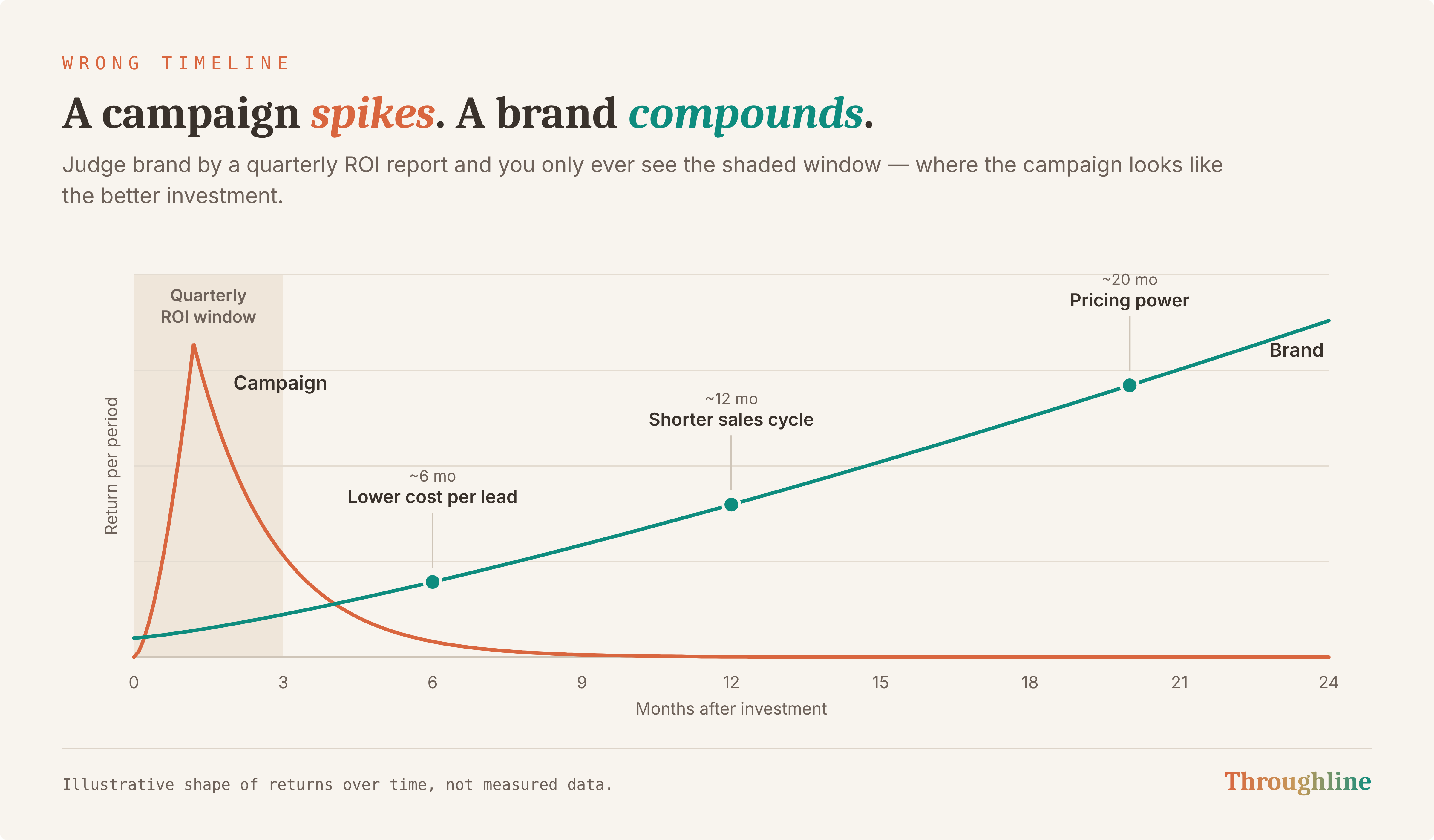
The instinct to report brand investment against a quarterly ROI number is understandable, but it's measuring the wrong thing on the wrong timeline. Brand doesn't convert on a landing page. It compounds — showing up as a lower cost per lead six months later, a shorter sales cycle a year later, and pricing power that shows up on the income statement long after the campaign that built it has ended. Trying to prove brand's value with the same dashboard used for a paid search campaign is like judging a retirement account by its return in week one.
The numbers that do exist, though, are exactly the kind of numbers a CFO already tracks.
The Numbers That Speak Finance's Language
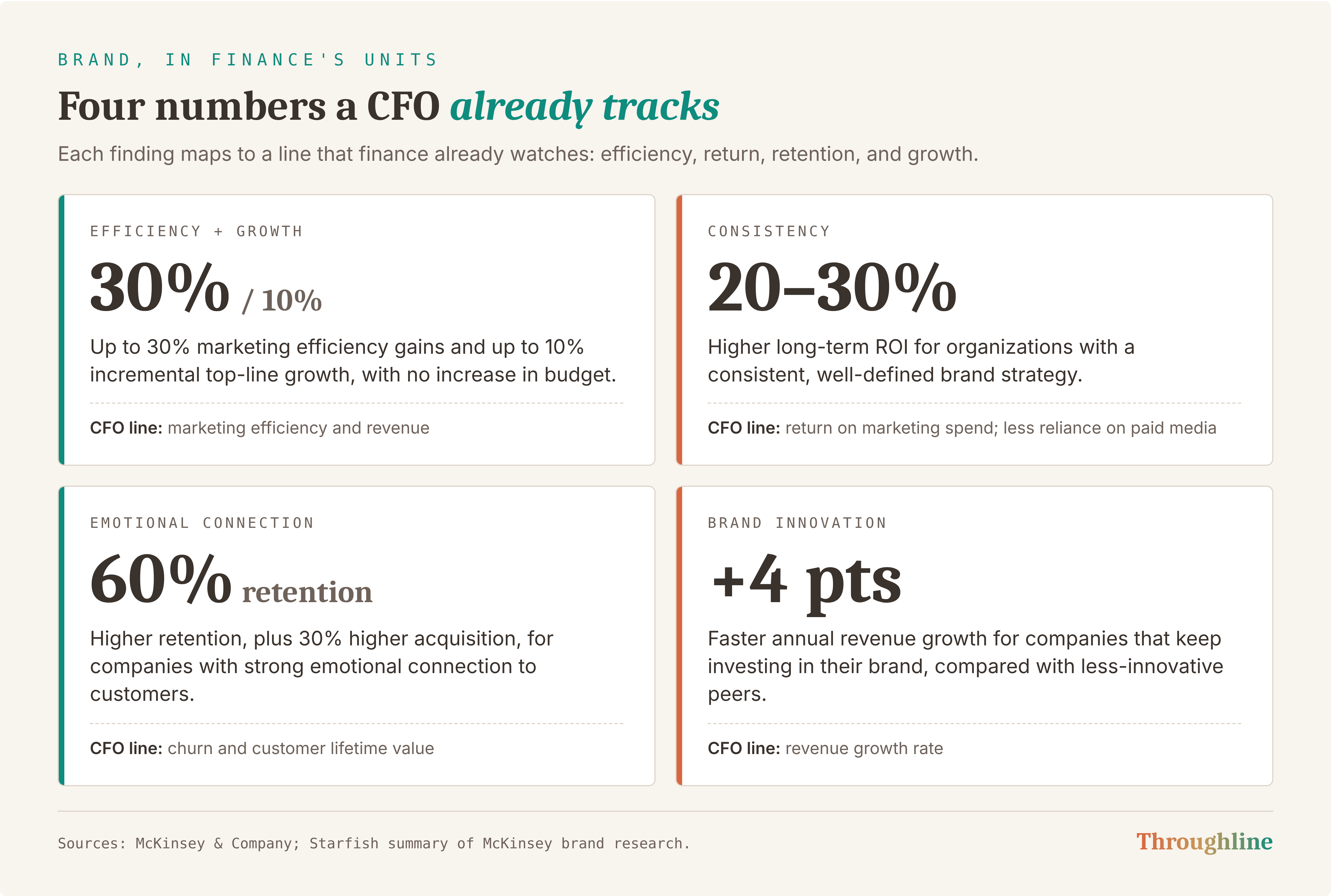
Efficiency and growth, together. McKinsey's research on data-driven brand measurement found that companies applying rigorous analytics to branding realized marketing efficiency gains of up to 30%, alongside incremental top-line growth of up to 10% — without increasing the marketing budget. That's not a brand metric. That's a margin and growth story, in the exact units a CFO evaluates every other investment against.
Consistency compounds. Organizations with a consistent, well-defined brand strategy have been shown to achieve 20 to 30% higher long-term ROI, alongside reduced dependence on paid media whose costs fluctuate with the market. For a CFO managing budget predictability, that second point matters as much as the first: brand equity is one of the few marketing assets that reduces a company's exposure to rising ad auction prices over time, rather than increasing it.
Emotional connection is a retention lever. Research on brand strength found that companies with strong emotional connection to their customers saw 30% higher acquisition rates and 60% higher retention than companies without it. Retention, in particular, is a number every CFO already has on a dashboard — and one where even small improvements compound dramatically across a customer base's lifetime value.
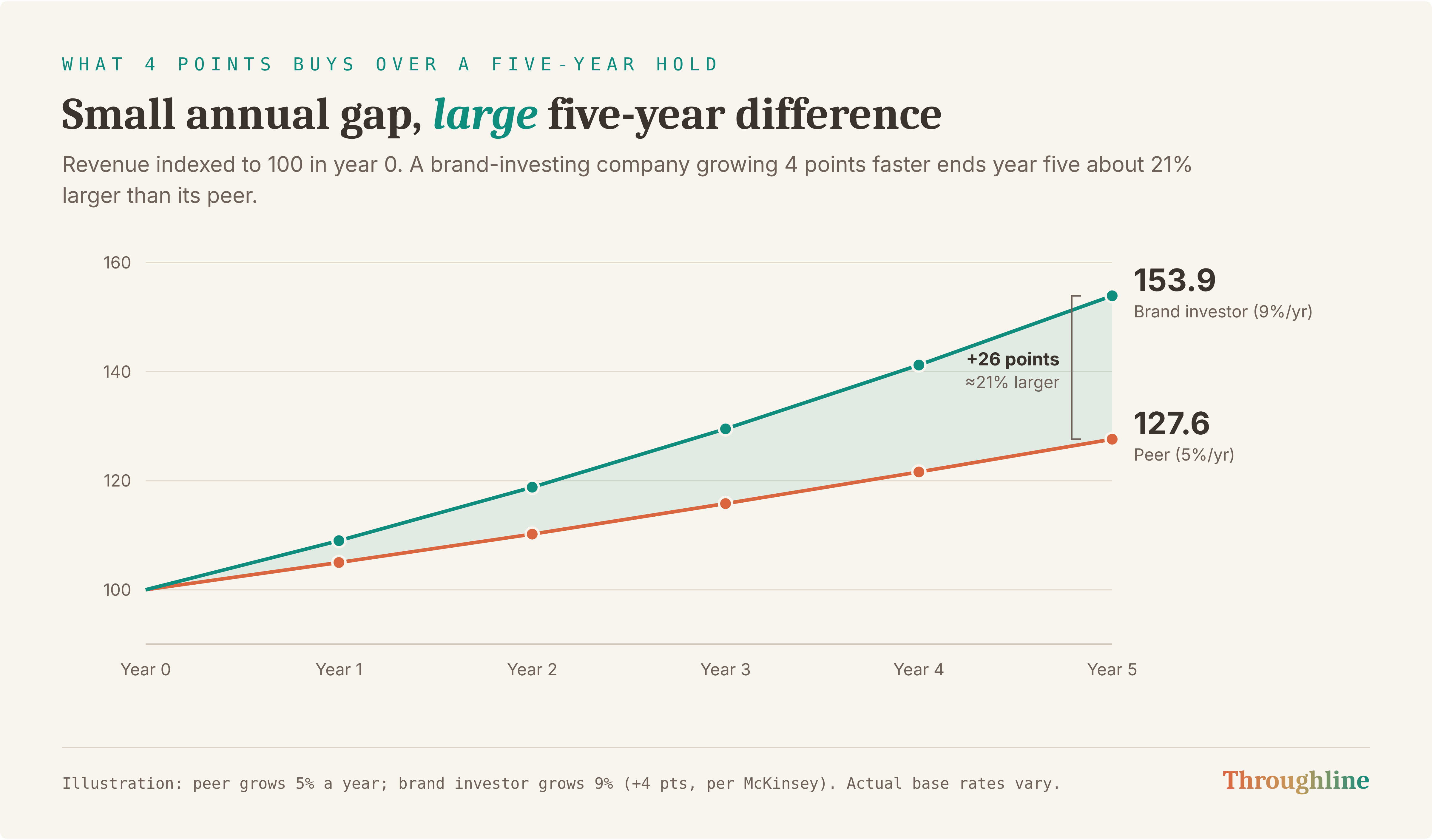
Brand-innovating companies outgrow their peers. McKinsey's longitudinal research on brand innovation found that companies that continually invested in their brand grew revenue 4 percentage points faster annually than less-innovative peers. Compounded over a five-year hold, that's the difference between a business that's grown modestly and one that's meaningfully outpaced its category.
Frame It the Way a CFO Already Thinks
The most effective way to make this case isn't a slide titled "why brand matters." It's connecting brand investment to the framework finance already uses to evaluate the business. If your company tracks something like the Rule of 40 — balancing growth rate against margin — brand has a direct, explainable place in that equation:
Lower CAC. Buyers convert faster and sales cycles shorten when the brand has already done part of the persuading before a rep ever gets on a call.
Pricing power. A well-positioned brand reduces the discounting a sales team feels pressured to offer to win a competitive deal, protecting margin directly.
Lower recruitment and attrition cost. A strong external brand is inseparable from a strong employer brand — and with the large majority of candidates now researching a company's reputation before applying, that has a real, measurable line item effect on hiring cost and speed.
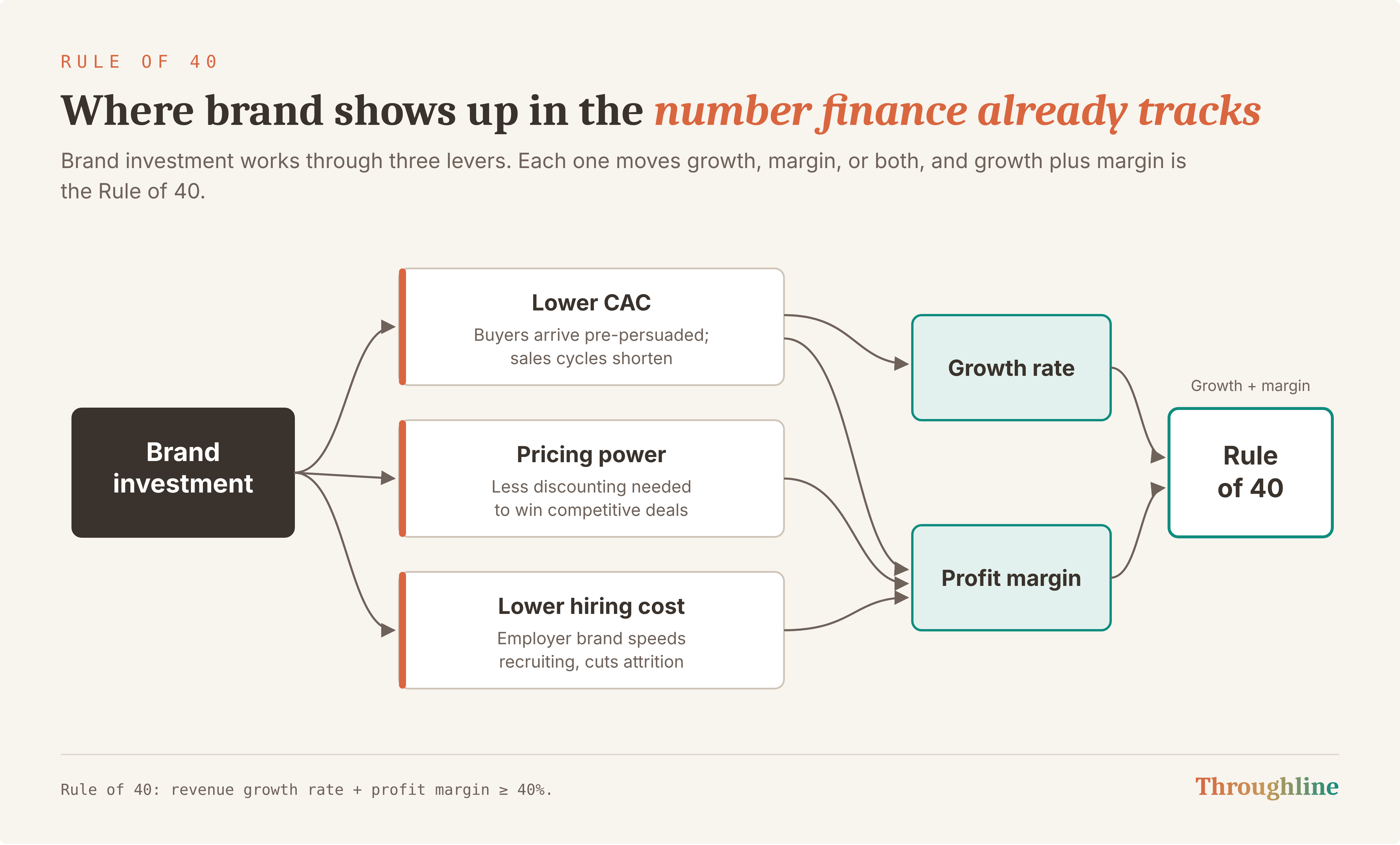
Framed this way, a brand-investment ask stops sounding like "we need $500K for creative." It becomes: "this investment is expected to reduce CAC by a defined percentage and improve margin contribution — here's how that shows up in the Rule of 40 number we're already tracking together."
The Conversation to Have Before the Budget Meeting
The mistake most marketing leaders make is bringing this case to finance for the first time during a budget defense, under pressure, after a cut has already been proposed. The more effective version of this conversation happens earlier and looks less like a pitch and more like a standing translation layer between two functions that are, in most companies, still speaking past each other.
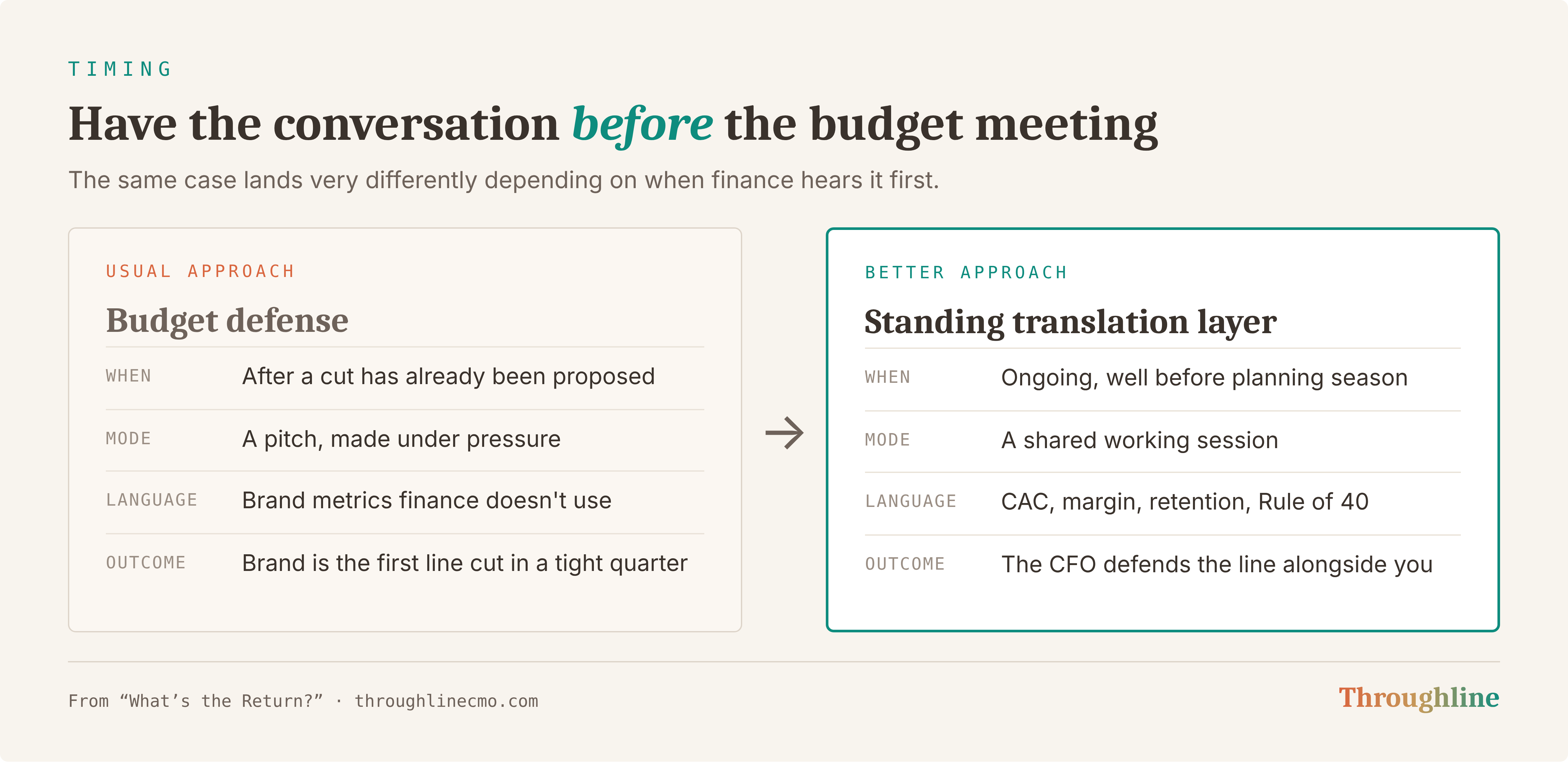
That's a large part of what a senior marketing leader is actually for — not just building the brand, but building the financial case for it in language the rest of the leadership team already trusts. Get that translation right, and brand investment stops being the first line cut in a tight quarter. It becomes the line the CFO defends alongside you.
Sources
- McKinsey & Company, "Performance branding and how it is reinventing marketing ROI"
- Starfish, "What McKinsey's Brand Strategy Research Tells Us in 2026" (summarizing McKinsey's brand consistency and emotional-connection research)
- McKinsey & Company, "The future of brand strategy: It's time to 'go electric'"