If you lead a growth-stage company, you've likely felt the pull toward the buyers who are ready right now. They fill out the demo form, they reply to your SDR's email, and they are in the pipeline report your board reviews every month. Investing there makes a lot of sense. Those are the deals that close this quarter.
What's easy to lose sight of, especially under quarterly pressure, is how small that group is at any given moment, and how much of next year's revenue is sitting in the much larger group that isn't shopping yet.
Most of your market is between purchases
Chet Holmes described this years ago in The Ultimate Sales Machine with what he called the Buyer's Pyramid. At any moment, about 3% of a market is actively buying and another 7% is open to it. The remaining 90% splits roughly evenly between people who aren't thinking about it, people who doubt they're interested, and people who are sure they aren't.
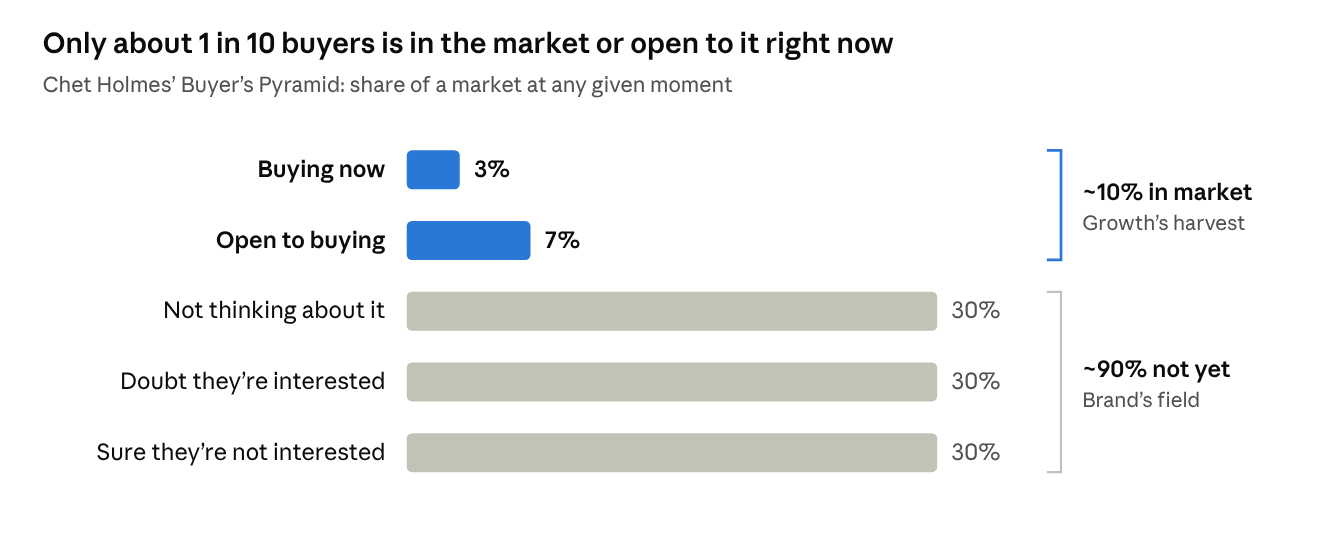
More recent research lands in a similar place. Professor John Dawes of the Ehrenberg-Bass Institute, working with LinkedIn's B2B Institute, estimated that in many B2B categories only about 5% of buyers are in market in a given quarter. His reasoning is straightforward: if companies replace a solution roughly every five years, about 20% will buy in a year, and about 5% in any one quarter. Dawes offers it as a rule of thumb, and the exact split varies by category and buying cycle. Whether the figure is 90% or 95%, the shape is the same: most of the people you'd love to work with aren't looking today.
That doesn't put them out of reach. They're under contract, mid-implementation, focused on other priorities, or reasonably happy with what they have. Their need will come back on its own schedule, and when it does, they'll start with the names they already know.
A farmer's way of looking at it
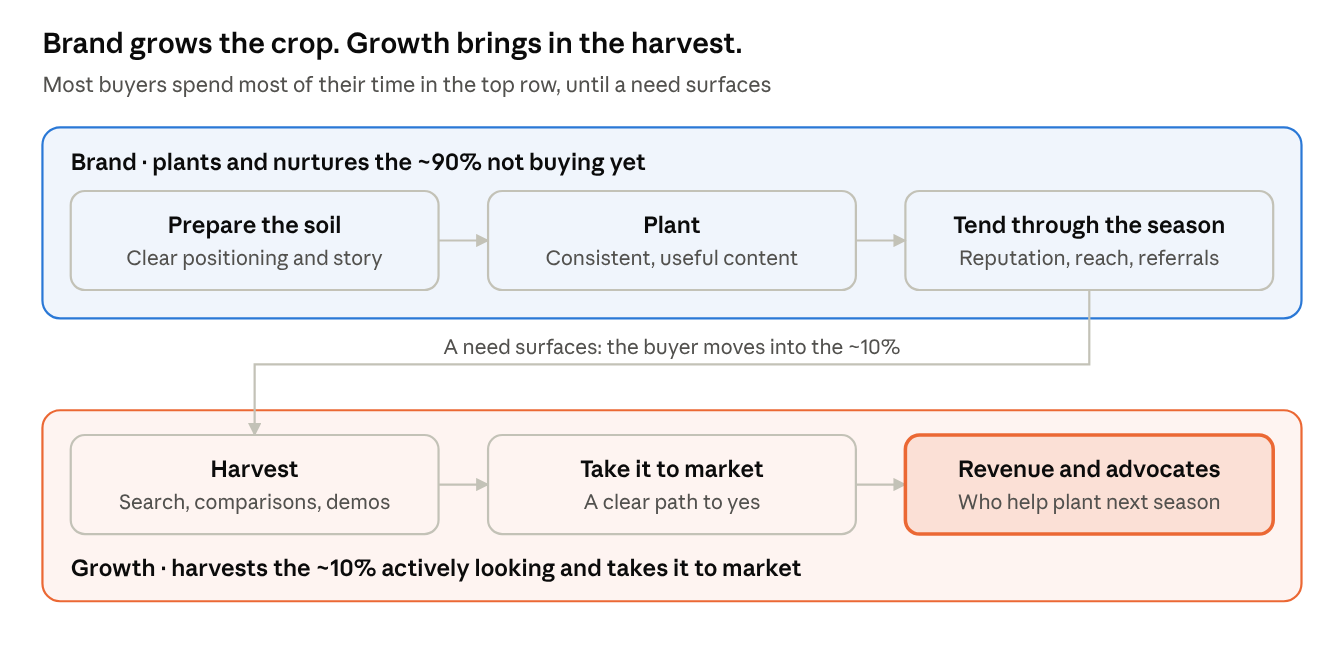
I find it helpful to think about this the way a farmer would. Farmers don't expect a harvest from a field they planted last week. They prepare the soil, plant, and tend the crop through the season, then bring in the harvest when it's ready and take it to market. Without the planting, there's nothing to harvest. Without the harvest, a good crop stays in the field.
Marketing works much the same way.
Brand plants and nurtures. Brand marketing reaches the 90% while they're between purchases. It's the point of view you share consistently, the content that helps people do their jobs better, and the reputation your customers carry into conversations with their peers. Its job is to build familiarity and trust, so that when a need surfaces, your name is one of the first that comes to mind. Researchers call this mental availability. A farmer would call it a healthy crop.
Growth harvests and takes it to market. Growth marketing meets buyers as they move into the 10% who are actively looking. It's your search presence, comparison pages, well-timed offers, a demo flow that makes saying yes easy, and the nurture that helps a buying committee build its case. Its job is conversion: turning readiness into revenue.
Why we need both
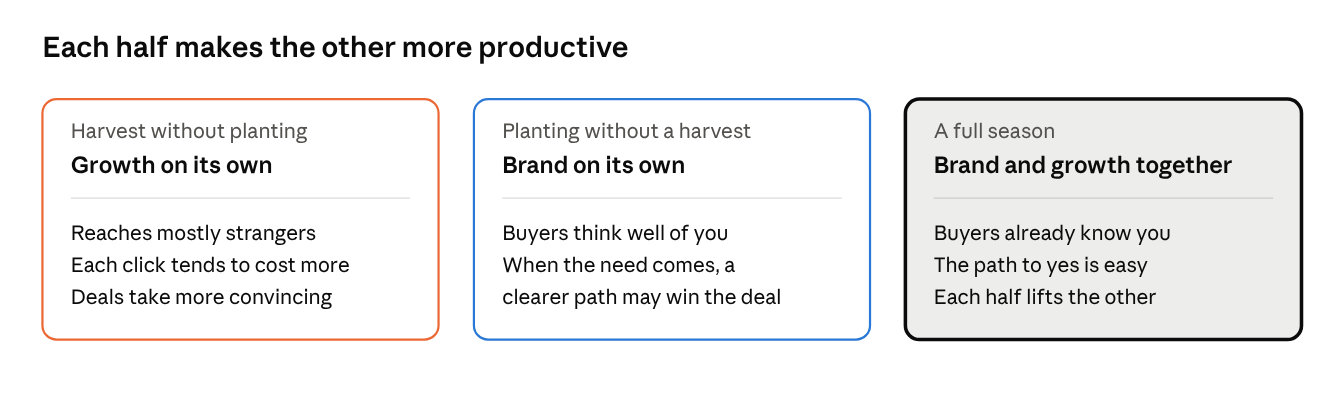
Each half makes the other more productive. When growth programs run with little brand behind them, they're working mostly with buyers who haven't heard of you yet, so each click tends to cost more and each deal takes more convincing. When brand runs without a strong growth engine, people may think well of you and still choose the competitor whose path to purchase was clearer when the moment came.
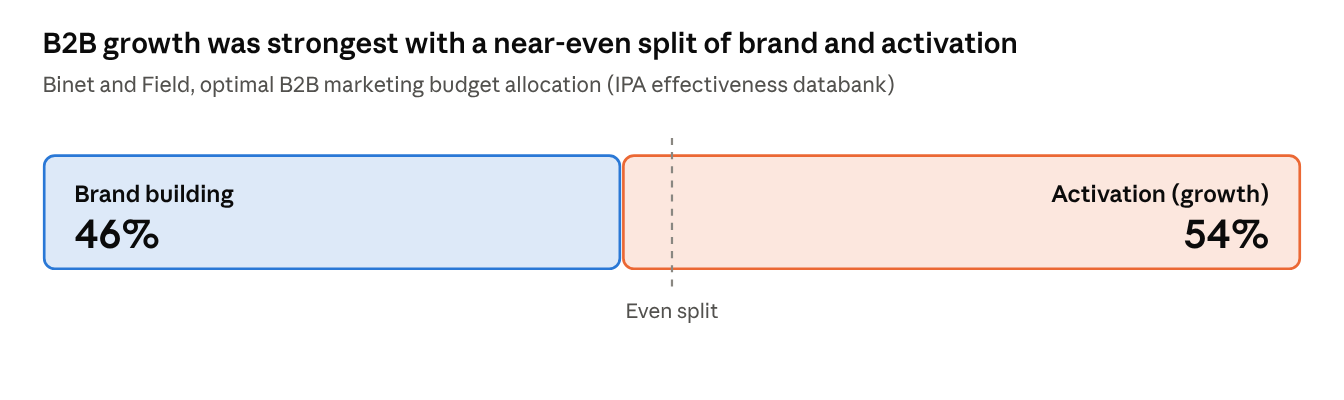
The research on balance is encouraging. In The 5 Principles of Growth in B2B Marketing, Les Binet and Peter Field analyzed B2B campaigns from the IPA effectiveness databank for LinkedIn's B2B Institute. They found B2B growth was strongest when budgets were split roughly 46% brand building and 54% activation. That's a benchmark rather than a prescription, and the right mix shifts with category and stage. The takeaway is reassuring, though: both halves earn their place.
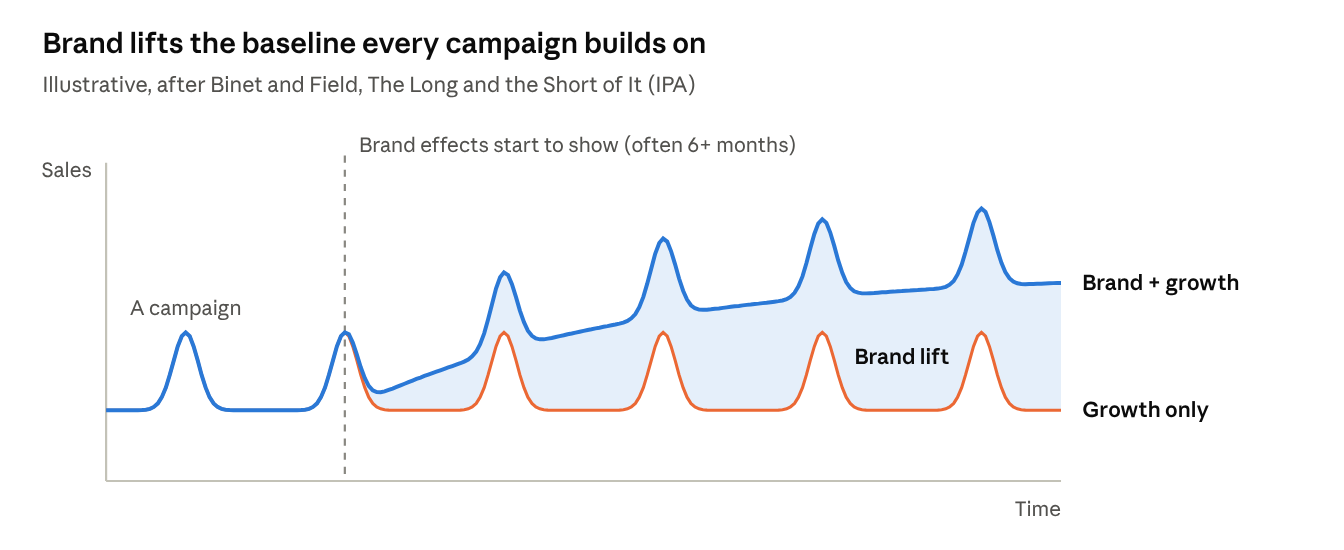
This also explains a pattern many of us have seen in our own pipeline reports. Brand work can feel slow because its results arrive later, and they're often credited to a growth channel when the buyer finally converts. Binet and Field found brand-building effects typically take at least six months to start showing. That's the season doing its work.
Where to start this season
If your growth engine is already producing, that's a strong base to build on, and you don't need to rebalance everything at once. A few steps can make a real difference this quarter:
- Know your harvest cycle. Look at how often customers in your category replace or renew a solution. That tells you roughly what share of your market is in play each quarter, and how long your brand work has to do its job.
- Plant one consistent message. Choose a single point of view on the problem you solve, and carry it through your content, social presence and sales conversations for at least two quarters.
- Measure the crop as well as the harvest. Alongside pipeline, track a few early signals, such as branded search, direct traffic, and how many new opportunities say they already knew you.
- Connect the field to the market. Make sure the story buyers hear while they're browsing is the same one they meet on your pricing page and in the first sales call.
The buyers who will choose you next year are out there today, going about their work. A little steady planting now means that when they're ready, you're the name they already trust. Pick one of these steps this week, and let the season begin.
Sources
- Chet Holmes, The Ultimate Sales Machine (Buyer's Pyramid), as summarized in an interview with Amanda Holmes, MarketingProfs
- Peter Weinberg and Jon Lombardo, "The 95:5 rule is the new 60:40 rule," Marketing Week, on research with Professor John Dawes, Ehrenberg-Bass Institute
- MiniMBA, "B2B brand building – using the 95:5 rule" (Dawes' calculation and caveats)
- Les Binet and Peter Field, The 5 Principles of Growth in B2B Marketing, The B2B Institute (LinkedIn)
- WARC, "B2B marketers need to enhance brand building" (six-month brand effect timeline)