Every B2B company has a funnel. Far fewer have a story.
The funnel is a diagram of stages; the story is the reason a buyer moves from one to the next. Without it, each stage is a handoff between strangers: an ad that promises one thing, a webinar that emphasizes another, a sales deck that opens somewhere else entirely. With it, the buyer never feels the seams.
Older Than Marketing, Older Than Writing
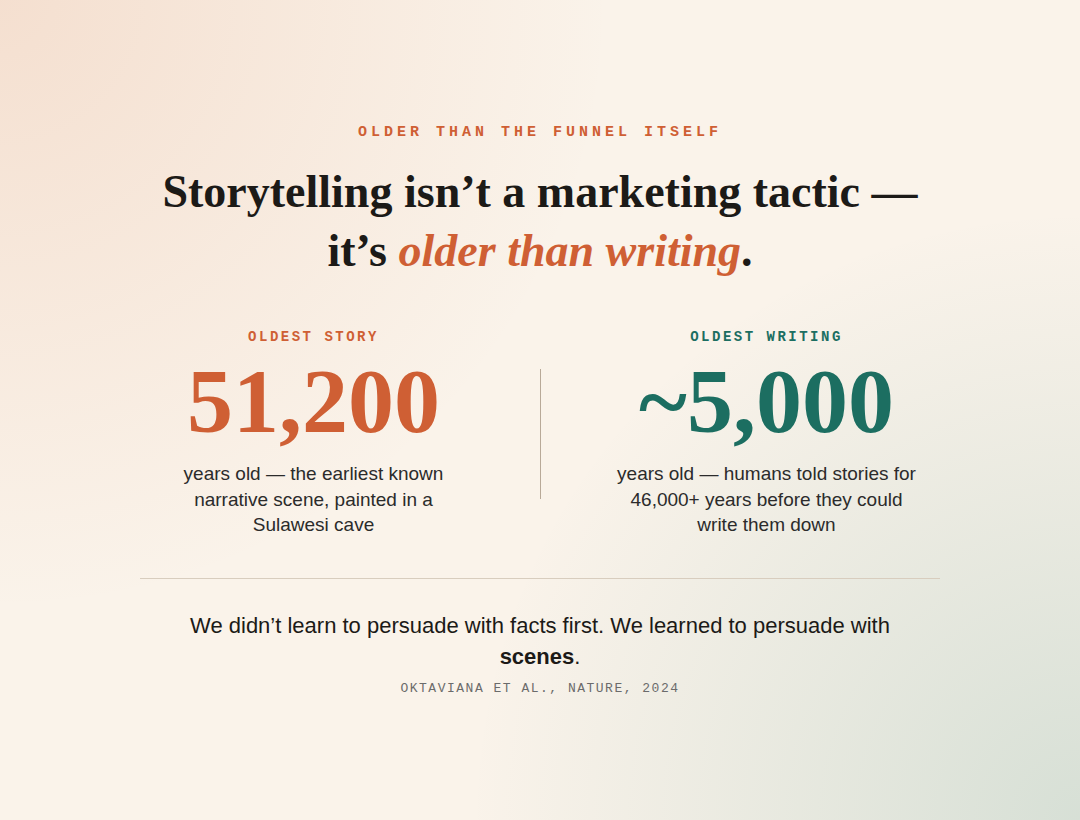
Marketing didn't invent storytelling; it borrowed it. In 2024, researchers dated a cave painting in Sulawesi, Indonesia, showing human-like figures interacting with a pig, to at least 51,200 years ago, making it the oldest known narrative scene in art. Words don't fossilize, so the telling almost certainly began earlier. Aristotle later gave the structure a name in the Poetics: a beginning, a middle, and an end, each following from the one before. Every framework since, from the three-act structure to the customer journey map, is a footnote to that idea.
Why Numbers Slide Off and Stories Stick
Humans did not evolve to process spreadsheets. We evolved to trade information in the form of events, characters, and consequences. Stanford's Chip Heath makes the point bluntly: numbers are not the natural language of people, so the moment you use them in an argument, translating them into human terms is your job.
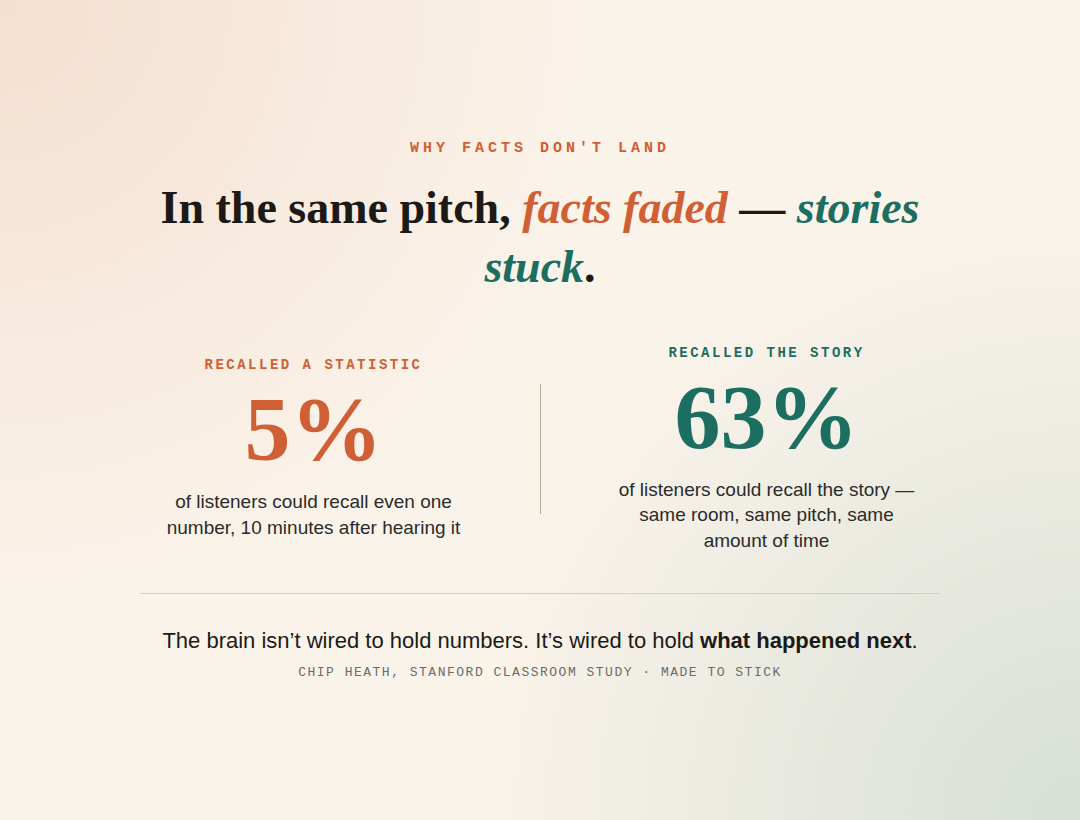
His classroom experiment shows the cost of skipping that step. Students gave one-minute persuasive pitches, averaging 2.5 statistics each, while only one in ten told a story. Ten minutes later, 5% of listeners remembered any statistic. Sixty-three percent remembered the stories. (You'll often see a “22x more memorable” figure attributed to Stanford research. Its origin is murky. The Heath result, roughly 12x, is the better-documented number, and it's still decisive.)
Neuroscience explains why. Princeton's Uri Hasson used fMRI to record a speaker telling a story, then scanned listeners hearing it. The listeners' brain activity mirrored the speaker's, and that coupling grew stronger as understanding grew and vanished when communication failed. A well-told story doesn't just transfer information; it synchronizes minds.
Separately, Paul Zak's lab found that character-driven stories trigger oxytocin release, and the amount released predicted how much people were willing to give to a cause tied to the narrative. His work also found that a story must first hold attention by building tension. Stakes are not decoration. They are the mechanism.
What It Means in Business Terms
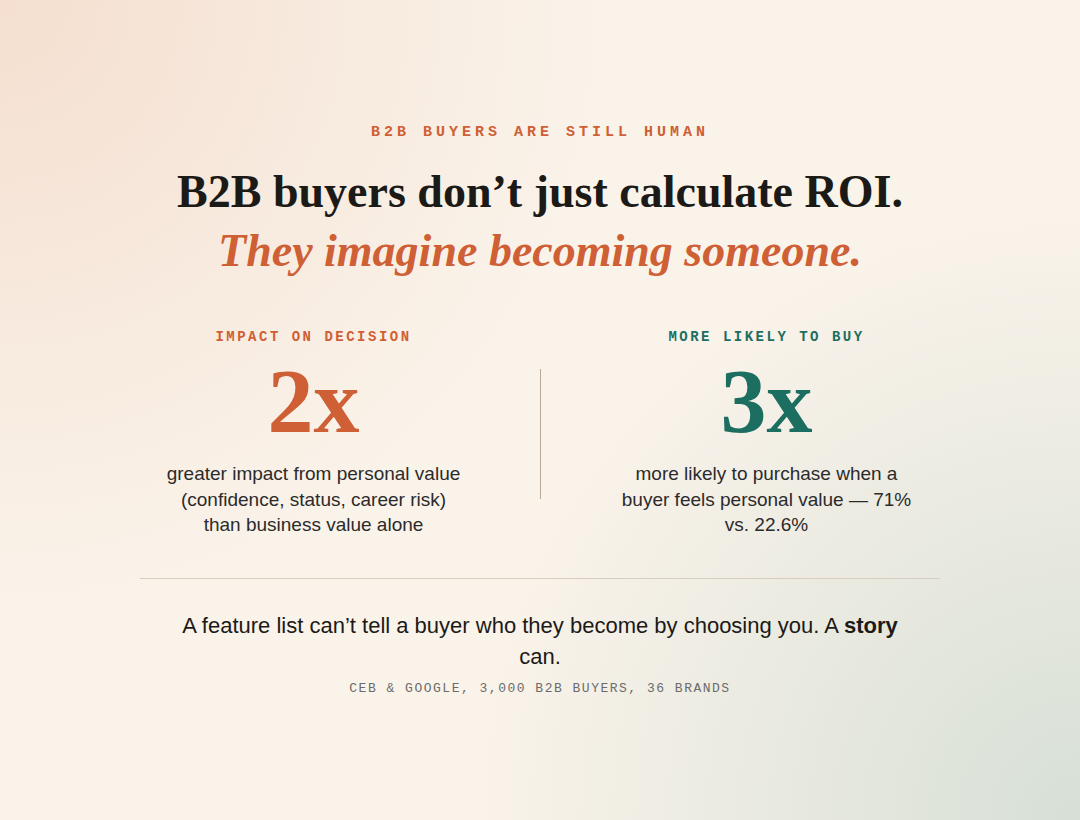
Skeptics assume this applies to consumers, not committees. The data says otherwise. In a study by CEB (now Gartner) and Google of roughly 3,000 B2B buyers across 36 brands, personal value—meaning confidence, career impact, and self-image—had twice the impact of business value on purchase outcomes. Buyers who saw personal value were more than three times as likely to say they'd buy (71% versus 22.6%) and about eight times more likely to pay a premium. A feature list can't tell a buyer who they become by choosing you. A story can.
It also has to work without you in the room. 6sense's 2024 research found buyers are roughly 70% through their purchase before they contact a seller, and 81% already have a preferred vendor. Your story is doing the selling during the part of the journey you don't attend.
At the page level, one luxury retailer's A/B test added a brand-story section to product pages and saw an 18% conversion lift and 12.7% revenue lift at 99% statistical confidence. That's a single B2C test, so treat it as directional, not universal. But it points the same way as everything above.
Every Scene Feeds the Next
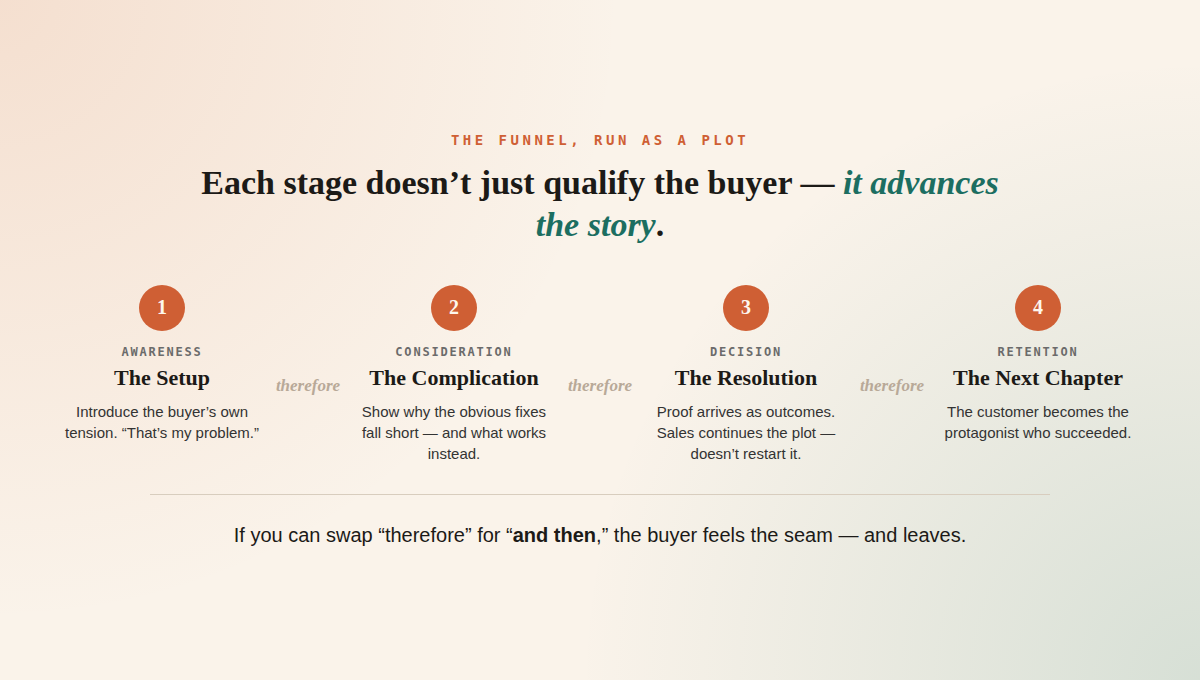
Screenwriters use a simple test: scenes should connect with “therefore” or “but,” never “and then.” If you can insert “and then” between two scenes, the second one didn't need the first, and the audience feels it.
Most go-to-market motions are “and then” machines. An awareness campaign leads with efficiency, and then a webinar leads with innovation, and then the sales deck leads with cost savings. Each asset may be well produced. None inherits anything from the one before, so the buyer has to reconcile three stories or, more often, quietly leaves.
Run the funnel as a plot instead:
Awareness is the setup. It introduces a character, your buyer, and a tension they recognize as their own. The goal isn't to explain your product; it's to make them say, “that's my problem.”
Consideration is the complication. Therefore, here's why the obvious solutions fall short, and what a better approach looks like. Each asset answers the question the previous one raised.
Decision is the resolution. Proof arrives as customer stories and outcomes, and the sales conversation picks up the plot rather than restarting it. The rep isn't introducing a new narrative; they're delivering the ending the buyer has already been following.
Retention is the next chapter. Onboarding and expansion continue the same story, with the customer now as the protagonist who succeeded.
Numbers Belong Inside the Story
None of this argues against metrics. It argues for sequence. The story earns attention and belief; the numbers supply proof once someone is already leaning in. A CFO will still want CAC, cycle length, and conversion rates, and a good story is what moves all three. Lead with the narrative, back it with the data, and both do their jobs.
Sources
- Oktaviana et al., “Narrative cave art in Indonesia by 51,200 years ago,” Nature, July 2024
- Chip and Dan Heath, Made to Stick (Stanford pitch experiment, as reported in secondary summaries)
- Stephens, Silbert, and Hasson, “Speaker–listener neural coupling underlies successful communication,” PNAS, 2010
- Paul J. Zak, “Why Your Brain Loves Good Storytelling,” Harvard Business Review, 2014
- CEB and Google, “From Promotion to Emotion: Connecting B2B Customers to Brands”
- 6sense, 2024 Buyer Experience Report
- ConversionTeam, brand storytelling A/B test case study