Ask ten people inside most B2B companies to describe what the company does, and you'll get ten different answers — a feature list from product, a category comparison from sales, a values statement from the founder, and a tagline from marketing that doesn't quite match any of the other three.
That inconsistency isn't a branding nitpick. It's actively costing pipeline, and the data on how B2B buyers actually operate explains exactly why.
The Buyer Has Already Decided Before You Know They Exist
The most commonly cited framework for the “funnel” assumes a buyer becomes aware of a company, considers it, and then a sales conversation moves them toward a decision. That model describes a buying process that mostly no longer exists.
According to Gartner, B2B buyers now spend as little as 17% of their total purchase journey actually interacting with potential suppliers — spread across every vendor they're considering, not just one.
Separately, 6sense's 2024 Buyer Experience Report found that buyers are, on average, nearly 70% of the way through their purchasing process before they ever engage a seller, and 81% already have a preferred vendor in mind at the moment of that first contact.
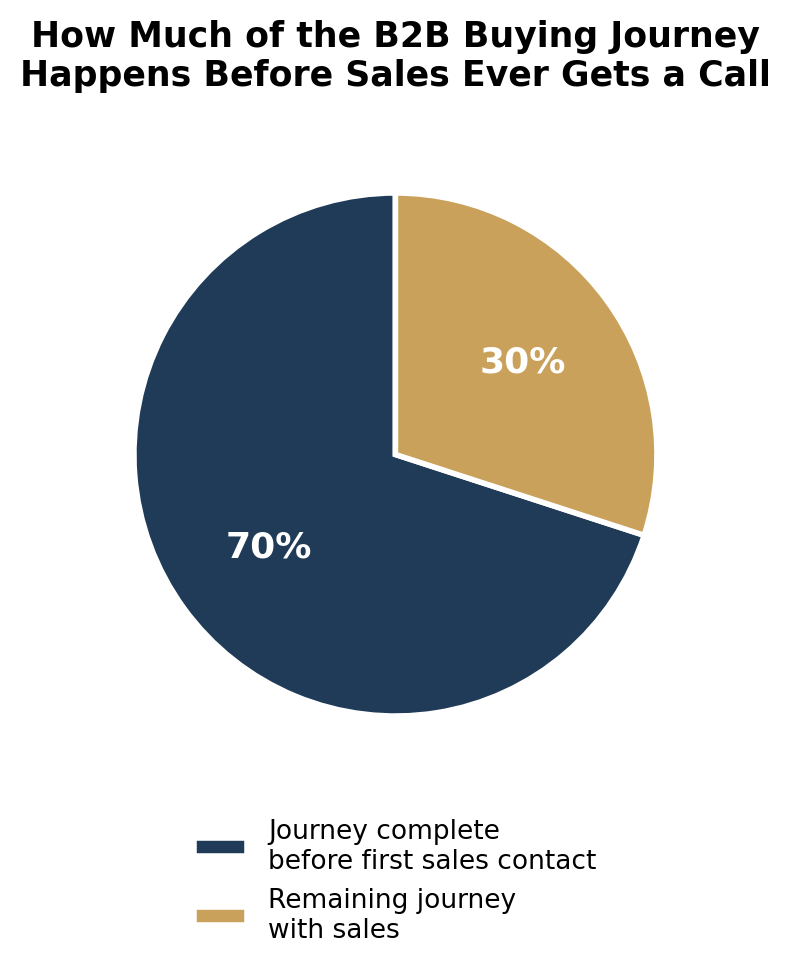
Read those numbers together and the implication is uncomfortable: your sales team is very rarely persuading anyone. In the large majority of deals, the decision about who's the frontrunner has already been shaped — by content the buyer read alone, by what came up when they searched, by what a peer said in a Slack channel your company was never part of, by the impression your website left in the ninety seconds before they moved on to a competitor's site. Sales is confirming a decision far more often than it's changing one.
Which means the highest-leverage moment in the entire buying journey is one almost no B2B company deliberately manages: the unaccompanied 70% where the buyer is forming their opinion with no one in the room to shape it except whatever the company has already put into the world.
What Positioning Actually Does
Positioning is the discipline of controlling that unaccompanied moment. It's not a tagline exercise or a slide in a pitch deck — it's the underlying, specific answer to three questions a buyer is silently asking as they research: What is this, exactly? Who is it for? Why does it matter more than the five other tabs I have open?
Most B2B companies answer these questions vaguely, if at all, because vague positioning feels safer — it doesn't rule anyone out, doesn't pick a fight with a category assumption, doesn't risk sounding narrow.
But vague positioning doesn't just fail to attract the right buyer; it fails to register at all in a research process that's happening largely without you. A buyer skimming five vendor sites in a single afternoon isn't parsing nuance. They're pattern-matching for clarity, and rewarding whoever provides it fastest.
This is precisely the gap a strong brand closes and precisely the gap most growth-stage companies never budget time to close, because it doesn't produce a number a demand generation dashboard can show by Friday. It shows up two quarters later, as a shorter sales cycle, a higher close rate, and a sales team that stops needing to “educate the market” on every single call because the market already understood the pitch before the call happened.
Why This Compounds With Demand Generation, Not Against It
Positioning and demand generation are often treated as competing budget lines — as if clarifying your message is a “brand” cost that trades off against the media spend that drives leads. That framing gets the relationship backwards. Clear positioning makes every dollar of demand generation spend more efficient: the same ad, aimed at the same audience, converts at a higher rate when the audience already has a coherent idea of what you do and why it matters to them. Unclear positioning doesn't just fail to help demand generation — it forces demand generation to do work it was never designed to do, using a paid channel to explain what a website should have made obvious in five seconds.
Companies that skip straight to scaling demand generation without fixing positioning first are, in effect, paying to drive more traffic into a leaky, confusing story — and then wondering why cost per lead keeps climbing even as spend increases.
Getting Positioning Right Isn't Guesswork
Good positioning isn't invented in a conference room through consensus, and it isn't copied from a competitor's homepage. It's derived from a clear-eyed read of the market category, the specific alternatives a buyer is actually weighing you against, and the attributes your best customers can articulate that your average customers can't. Done well, it produces language specific enough that a stranger could read your homepage and correctly guess who your ideal customer is — which is a bar most B2B websites, if you're honest, don't currently clear.
Fixing this isn't a rebrand. It's usually a repositioning: the same product, the same team, but a materially sharper answer to what you are, who you're for, how you're different, and why that matters — built to win the 70% of the buying journey that happens before anyone from your company is in the room.