Until recently, marketing leadership at an early-stage company came down to one of two choices: hire a full-time chief marketing officer, or go without one.
A third path has opened up, and a growing number of companies are taking it. Instead of committing to a full-time hire, they bring in a fractional CMO — someone who takes on executive-level marketing leadership for a set number of hours a week.
That's a different job than a freelance marketer or an agency account lead. A fractional CMO owns positioning, go-to-market strategy, demand generation, team development, budget decisions, and how all of it gets measured. Companies get that level of ownership without signing up for a permanent C-suite hire before they're ready for one.
The Old Binary Is Breaking
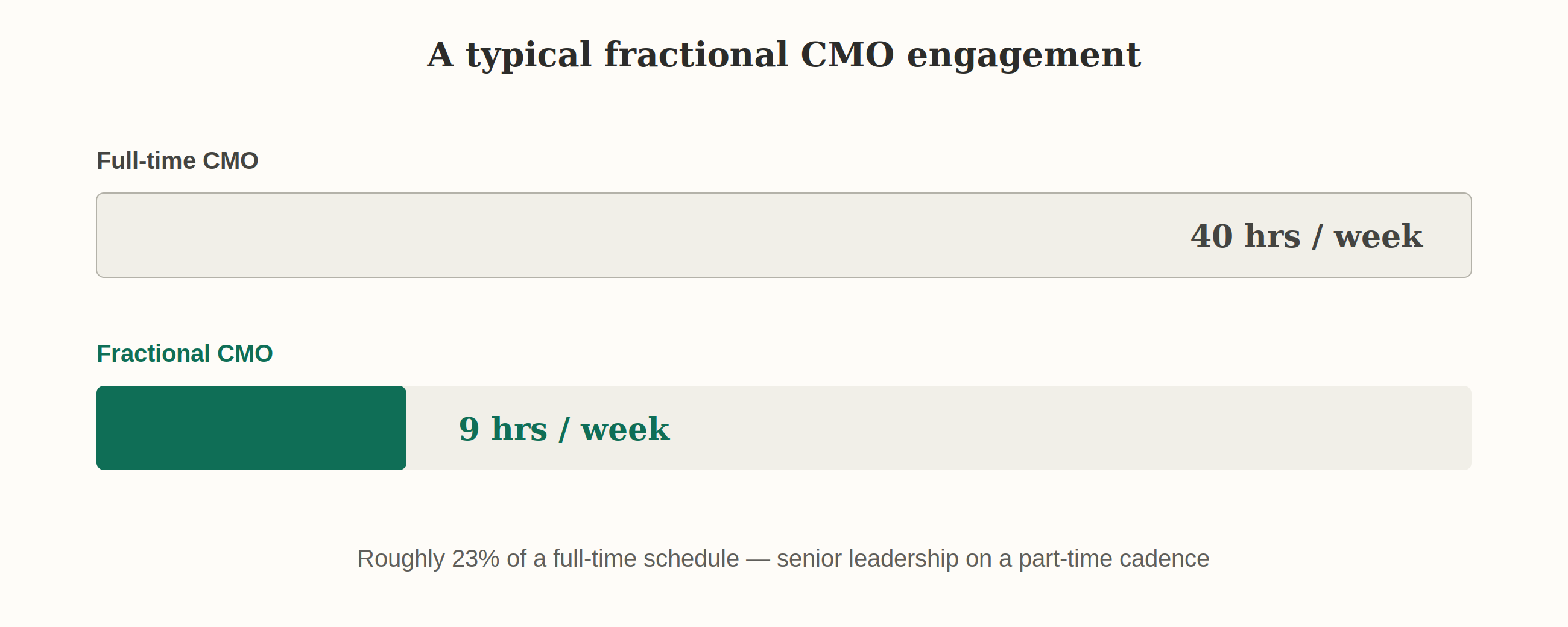
Go Fractional's market data gives a decent picture of how this plays out in practice. A typical fractional CMO engagement runs about 9 hours a week, which works out to roughly 23% of a full-time schedule. The average rate is around $180 an hour, and the middle half of observed rates fall between $125 and $220.
For founders, the appeal usually comes down to timing. Rather than hiring a senior executive before the company can really put one to use, they get that level of thinking on tap, whenever the business needs it.
The Founder-Led Marketing Ceiling
In the early days, founders usually end up running marketing themselves, mostly by default. They talk to customers, write the first version of the messaging, test a few channels, and decide where the limited budget goes. That works fine while the company is still looking for product-market fit.
At some point, though, founder-led marketing stops scaling. The messaging has to hold together across the website, the sales deck, the campaigns, and the investor updates. Sales needs an actual definition of a qualified lead. Spending must connect to results someone can point to. Agencies and freelancers need real direction, not just a brief.
A lot of companies get stuck here. Either they hire a junior marketer who's good at execution but hasn't run a company's strategy before, or they end up with three or four vendors working in parallel with no one steering the ship. A fractional CMO is meant to close that specific gap. Not by overriding what the founder already built, but by turning it into something the team can repeat: sharper positioning, more disciplined channel bets, and a marketing function that answers for revenue instead of activity.
Why the Economics Make Sense
There's a financial argument here too, and it's a direct one.
Senior marketing talent isn't cheap, which matters a lot when a company is watching its runway. The Bureau of Labor Statistics puts the median salary for a marketing manager at $161,030 as of May 2024, with the top 10% clearing $239,200. Those numbers cover a broad management category rather than the CMO title specifically, but they give a sense of the floor.
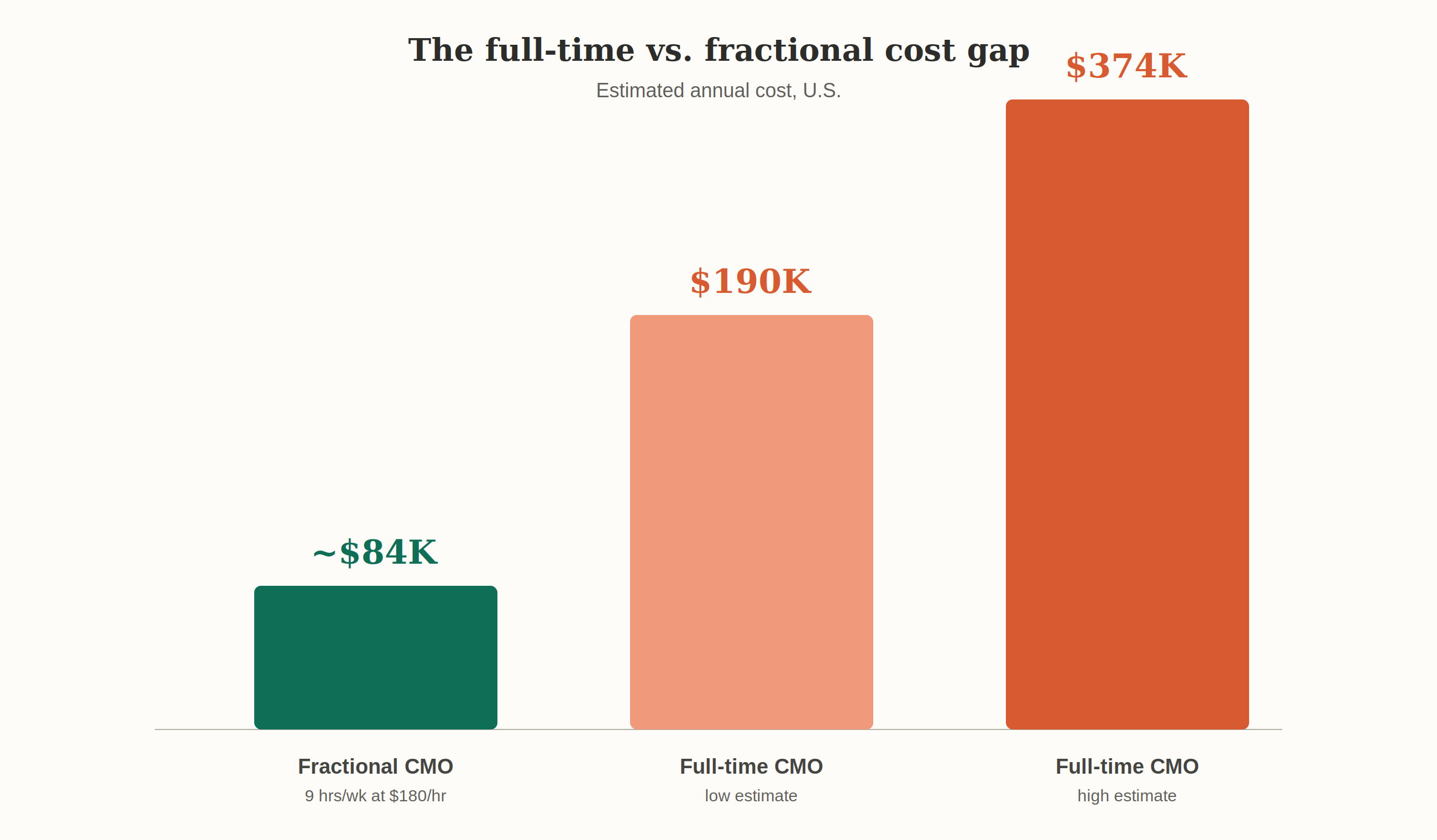
Actual CMO pay runs higher. One 2026 benchmark analysis puts total compensation somewhere between $190,000 and $374,000, and that's before benefits, bonus, equity, recruiting fees, and the months it usually takes to get someone fully up to speed.
Fractional work changes that math. At the rates and hours cited above, a fractional CMO runs a company somewhere around $84,000 a year. That's not nothing, and a good fractional operator shouldn't be treated as a discount stand-in for a real executive. But it buys a defined amount of senior judgment, and a company can adjust that scope as needs change, which a full-time hire doesn't really allow for.
The Pressure to Do More With Less
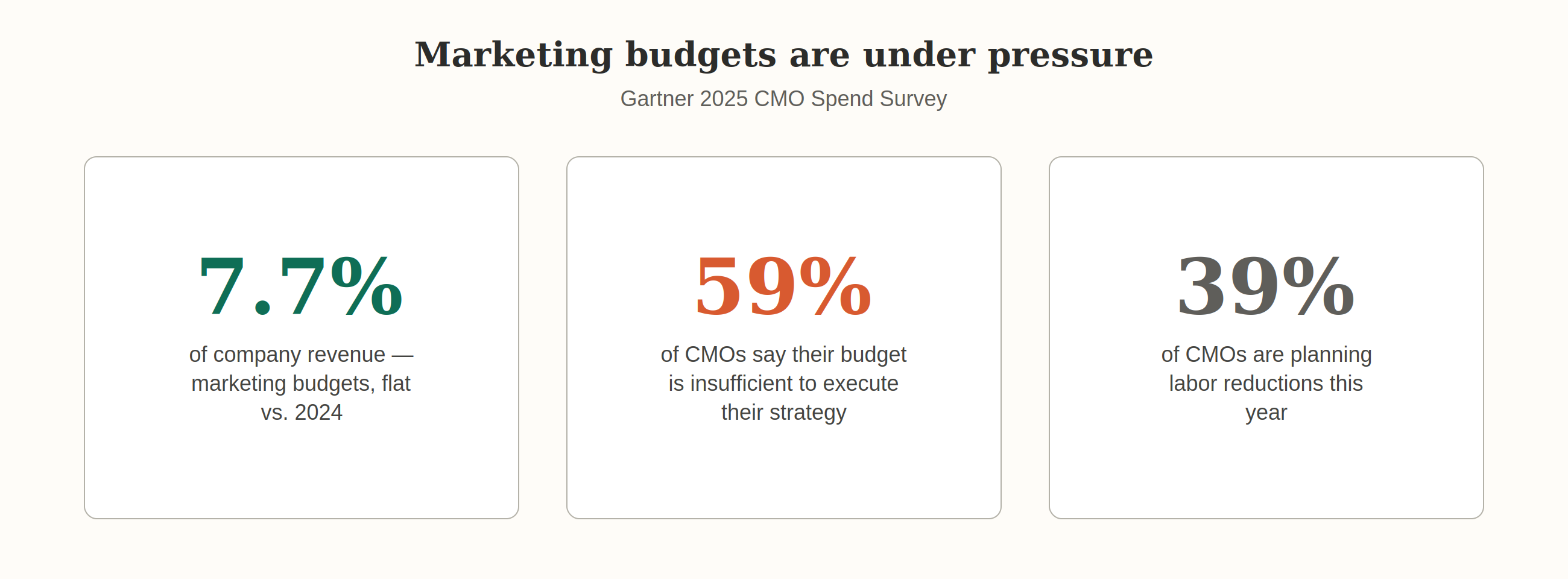
None of this is happening in a vacuum. Gartner's 2025 CMO Spend Survey found marketing budgets sitting flat at 7.7% of company revenue. Fifty-nine percent of CMOs say that isn't enough to execute their strategy, and 39% are planning to cut headcount this year.
For an early-stage company, that doesn't mean marketing should shrink. It means every dollar needs a clearer reason behind it — which customer segments actually matter, which message is landing, which channels are building pipeline, and where money is quietly disappearing. This is the kind of decision a fractional CMO is built to make: setting the roadmap, putting a real measurement system in place, and figuring out whether the next hire should be full-time, an agency, an in-house specialist, or some mix of the three.
A Better Fit Than an Agency Alone
Agencies still matter, especially for specialized work like paid media, content, PR, or building a website. But an agency does its best work when someone on the client side is setting priorities and connecting that work back to business goals.
A fractional CMO can be that person — the one who can answer questions an agency isn't really positioned to answer, like who the ideal customer actually is, what the company should stand for, which bets are worth funding, and how marketing should work with sales, product, and customer success.
None of this is an argument against agencies. It's an argument for having someone senior steering before the agencies start executing. Companies tend to get more out of a lean internal team paired with a few well-chosen specialists than they do from a pile of vendors with nobody directing the work.
When It's the Right Time to Hire
A fractional CMO isn't the right move for every early-stage company. One that's still hunting for product-market fit probably needs hands-on customer discovery more than executive infrastructure. A company that already has a strong in-house marketing leader might just need more people executing, not more strategy.
That said, a few situations tend to call for this model:
Early traction, unclear positioning. The product works, but nobody's sharpened the story that's supposed to sell it.
Rising CAC with no clear cause. Channels are getting more expensive and no one senior is digging into why.
Agencies running without direction. The vendors are doing good individual work, but they're not pulling in the same direction.
A specific inflection point. A launch, a funding round, or a repositioning that calls for senior judgment for a while, not forever.
A founder who can't keep making every marketing call. The company has outgrown founder-led marketing but isn't ready for a full executive team.
Having access to that kind of expertise on a flexible basis lets a growth company build real marketing infrastructure before committing to a permanent executive team, without staking six figures on a role before the business can use it.
Sources
- Go Fractional, “Fractional CMO Benchmarks (2026)”
- U.S. Bureau of Labor Statistics, “Advertising, Promotions, and Marketing Managers”
- GTM 8020, “CMO Salary Statistics: 2026 Compensation Report and Trends”
- Gartner, “2025 CMO Spend Survey Reveals Marketing Budgets Have Flatlined at 7.7% of Overall Company Revenue”