For the last decade, B2B marketing has run on a single, seductive promise: skip the slow work, go straight to pipeline.
Stand up the ads, build the funnel, buy the intent data, and let performance marketing do the rest. It's measurable, it's fast, and it's what CFOs want to see in a board deck.
It's also, according to the people who study marketing effectiveness for a living, the reason so much demand generation spend underperforms.
The Rush to Demand Gen
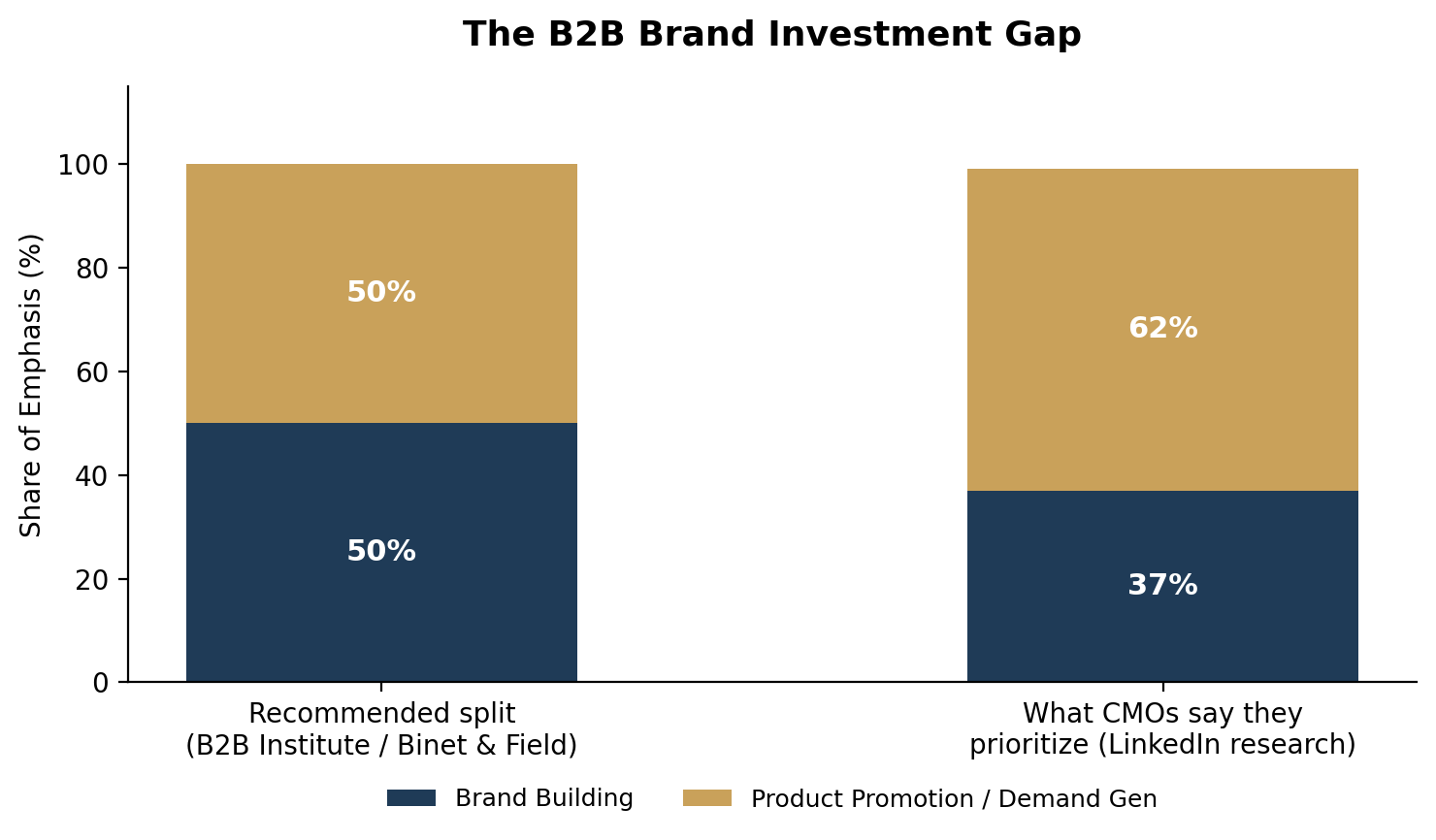
Walk into almost any B2B marketing org today and you'll find the same org chart priority: a demand generation team fully staffed, a marketing automation platform fully licensed, and a brand function that's either a single person, a line item cut in the last budget review, or simply absent. Leadership research from LinkedIn's B2B Institute captured this bias directly: when CMOs were asked where they place their emphasis, 62% pointed to product promotion, while only 37% pointed to brand building. That's nearly a two-to-one tilt toward the short term, in a discipline where the research says the split should run close to even.
This isn't a fringe pattern — it's the default operating model for most growth-stage and mid-market B2B companies. The logic is understandable: demand generation produces a number you can put in a spreadsheet by Friday. Brand building produces a number that shows up in eighteen months, in the form of shorter sales cycles, higher win rates, and lower cost per acquisition. One is a sprint with a stopwatch. The other is training for a marathon nobody's timing yet — which makes it the easiest budget line to defer.
What the Research Actually Says
The most influential work on this question comes from Les Binet and Peter Field, whose analysis of decades of IPA effectiveness data produced what's now known across the industry as the 60/40 rule: for optimal long-term profit growth, roughly 60% of marketing investment should go toward brand building, with 40% directed at short-term activation. When the B2B Institute commissioned Binet and Field to apply the same rigor specifically to B2B, the recommended split moved even closer to parity — a near 50:50 balance between brand and activation.
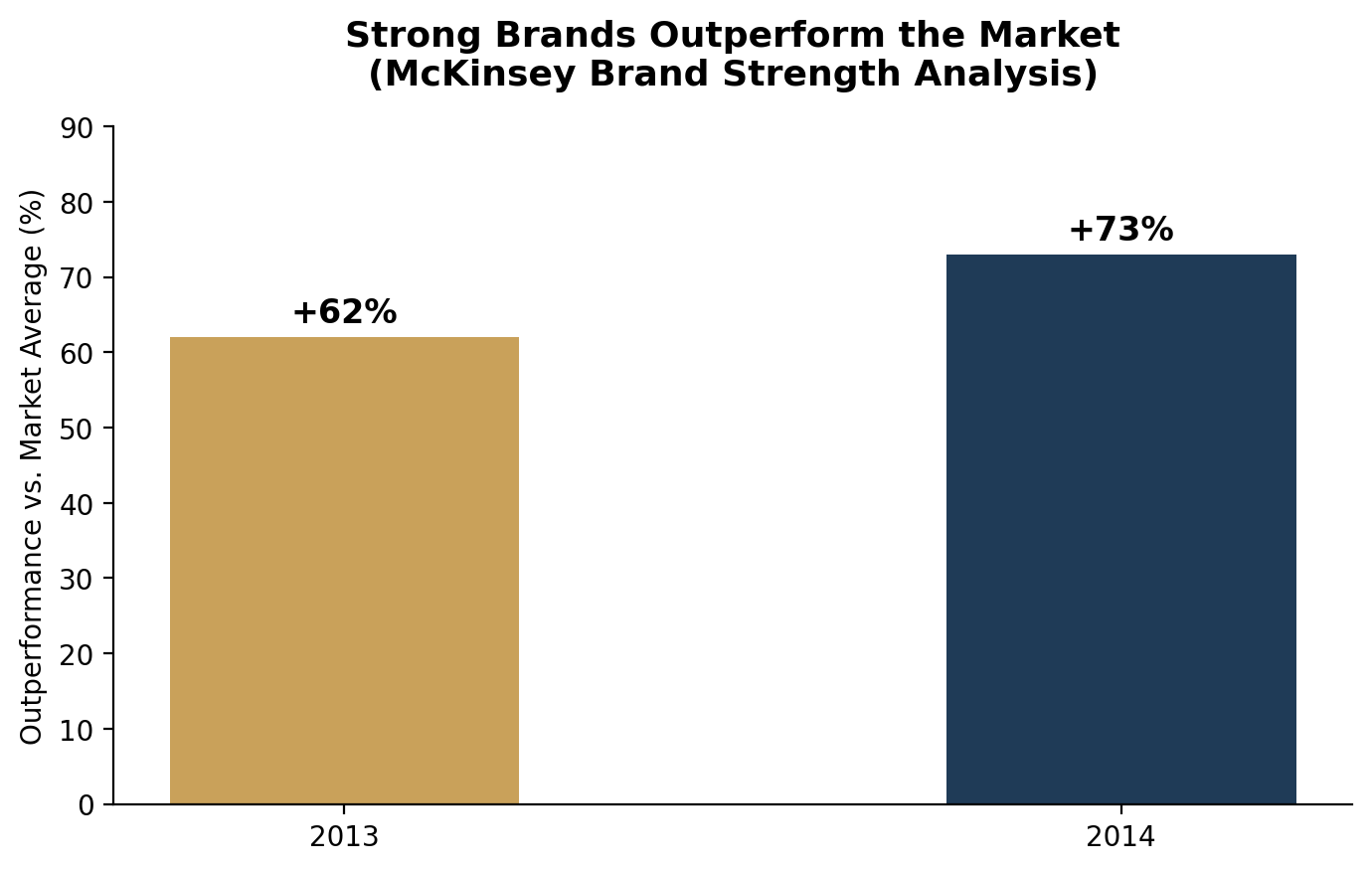
McKinsey's research adds hard financial weight to that argument. In its long-running analysis of brand strength and stock performance, McKinsey found that portfolios of strong brands outperformed the broader market by 62% in 2013 and by 73% in 2014 — and that the gap has continued to widen through subsequent economic cycles, including downturns, when weaker brands are typically forced to compete on price.
That advantage isn't confined to consumer categories. McKinsey's consumer-goods research found that brand innovators — companies that continually invest in and evolve their brand — grew their top line 4 percentage points faster than less-innovative competitors over a five-year period. And in its most recent survey of senior marketing leaders heading into 2026, McKinsey found that branding has reclaimed the #1 priority ranking among CMOs — ahead of performance-marketing optimization and even generative AI — precisely because organizations with a clear, consistent brand strategy are proving to be the ones absorbing shocks and sustaining growth, while companies that leaned hardest into short-term tactical optimization saw early gains erode.
Why This Matters More in B2B, Not Less
There's a persistent myth that brand is a consumer-marketing concern — that B2B buyers are rational actors who research their way to the “objectively best” vendor, making brand irrelevant. The data doesn't support this. B2B purchase decisions are made by committees of risk-averse individuals spending someone else's money, in categories where the buyer often can't fully evaluate the product before committing. In that environment, brand isn't decoration — it's a risk-reduction mechanism. It's the reason a buyer includes you on the shortlist before your SDR ever calls, and the reason your sales team isn't discounting to close.
This is precisely what strong brands buy a company: faster consideration, lower price sensitivity, and — critically for anyone running demand generation — a lower cost per lead and higher conversion rate on every campaign, because the audience already has a favorable predisposition before the ad ever runs. Demand generation without brand isn't cheaper marketing. It's marketing that has to work harder, for less trust, at a higher cost, campaign after campaign, with no compounding return.
The Fractional CMO's Job: Sequence, Not Just Spend
The strategic error most growth-stage companies make isn't spending on demand generation — it's spending on demand generation instead of, rather than on top of, brand. You cannot performance-market your way out of a positioning problem. If the market doesn't know who you are, doesn't understand what makes you different, or doesn't trust you enough to take the meeting, no amount of retargeting budget fixes that. It just makes the leak in the funnel more expensive to run water through.
A fractional CMO's role, particularly for a growth-stage or mid-market company that has never had senior marketing leadership, is to correct the sequence before optimizing the tactics: define the brand's real point of differentiation, build the message architecture the whole go-to-market motion can stand on, and only then scale demand generation against a foundation that makes every dollar of that spend work harder and last longer.
The companies winning right now aren't choosing between brand and demand. They're building both, in the right order, at the ratio the research has been pointing to for a decade. The only question is how much longer the rest of the market keeps ignoring it.
Sources
- McKinsey & Company, “The brand is back: Staying relevant in an accelerating age”
- McKinsey & Company, “The future of brand strategy: It's time to ‘go electric’”
- McKinsey & Company, “Past forward: The modern rethinking of marketing's core”
- LinkedIn B2B Institute / Les Binet & Peter Field, The 5 Principles of Growth in B2B Marketing
- Les Binet and Peter Field, The Long and the Short of It: Balancing Short and Long-Term Marketing Strategies