In a recent post, I wrote about how a clear story helps each stage of the funnel lead naturally to the next. This time I want to show what that looks like in practice, through one of my favorite examples in B2B: Zuora.
Zuora’s story is especially encouraging if you sell something that’s hard to make exciting. Its product is subscription billing software. Billing matters a great deal to the companies that rely on it, but it isn’t usually the stuff of keynotes and bestselling books. Zuora got both anyway, because it found a story bigger than its product and told it consistently for nearly two decades.
Creating the Story: Name the Shift
Zuora was founded in 2007 by Tien Tzuo, who had previously served as chief marketing officer and chief strategy officer at Salesforce. The company could easily have introduced itself as a better billing system. That would have been accurate, and it’s what many of us would have done.
Instead, Zuora named a change in its customers’ world. It coined the phrase “subscription economy” to describe how buyers were moving away from one-time purchases toward recurring services, choosing access over ownership. The phrase wasn’t about Zuora at all. It described what was happening to its customers, which is exactly what made it powerful. A prospect could believe in the shift long before they believed in the vendor.
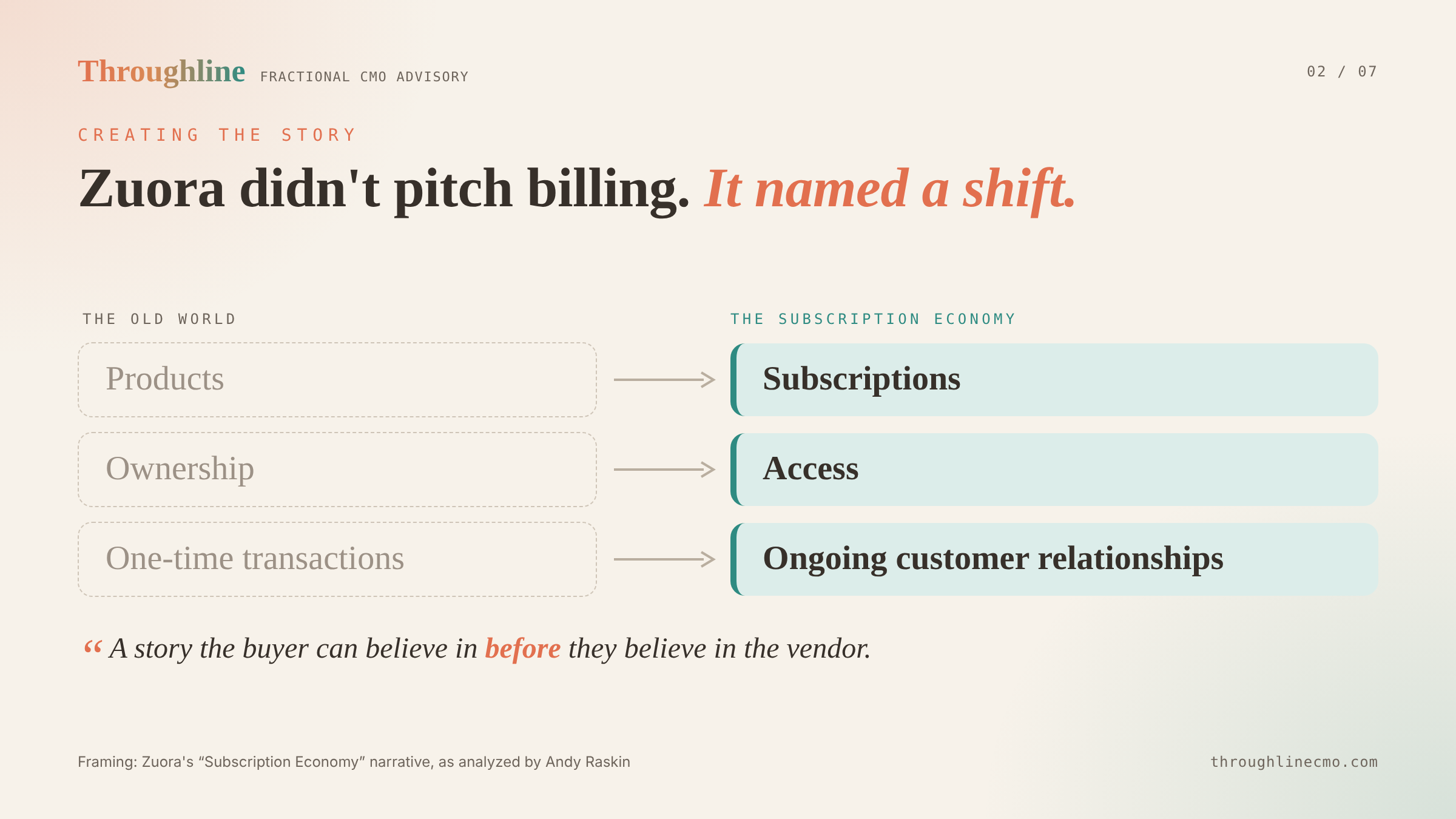
Messaging strategist Andy Raskin, who has written extensively about Zuora, points out why this works so well. Telling prospects they have a problem tends to put them on the defensive. Describing a change in the world invites them to talk openly about how it affects them and where they see opportunity. It turns a pitch into a shared conversation.
Building the Story: A Sales Deck With a Plot
In 2016, Raskin wrote a post about Zuora’s sales deck that he titled “The Greatest Sales Deck I’ve Ever Seen.” It drew more than a million views and inspired many companies to rebuild their own decks.
What he admired was the structure. The deck moved through five beats, in order:
- A big change in the world: the rise of the subscription economy.
- Winners and losers: companies that adapted to the shift were thriving, and those that didn’t were struggling to keep up.
- A promised land: a clear picture of what winning in the subscription economy looks like.
- Features as tools for the journey: product capabilities, introduced as the means of getting there.
- Proof: customer stories showing others who had already made the trip.
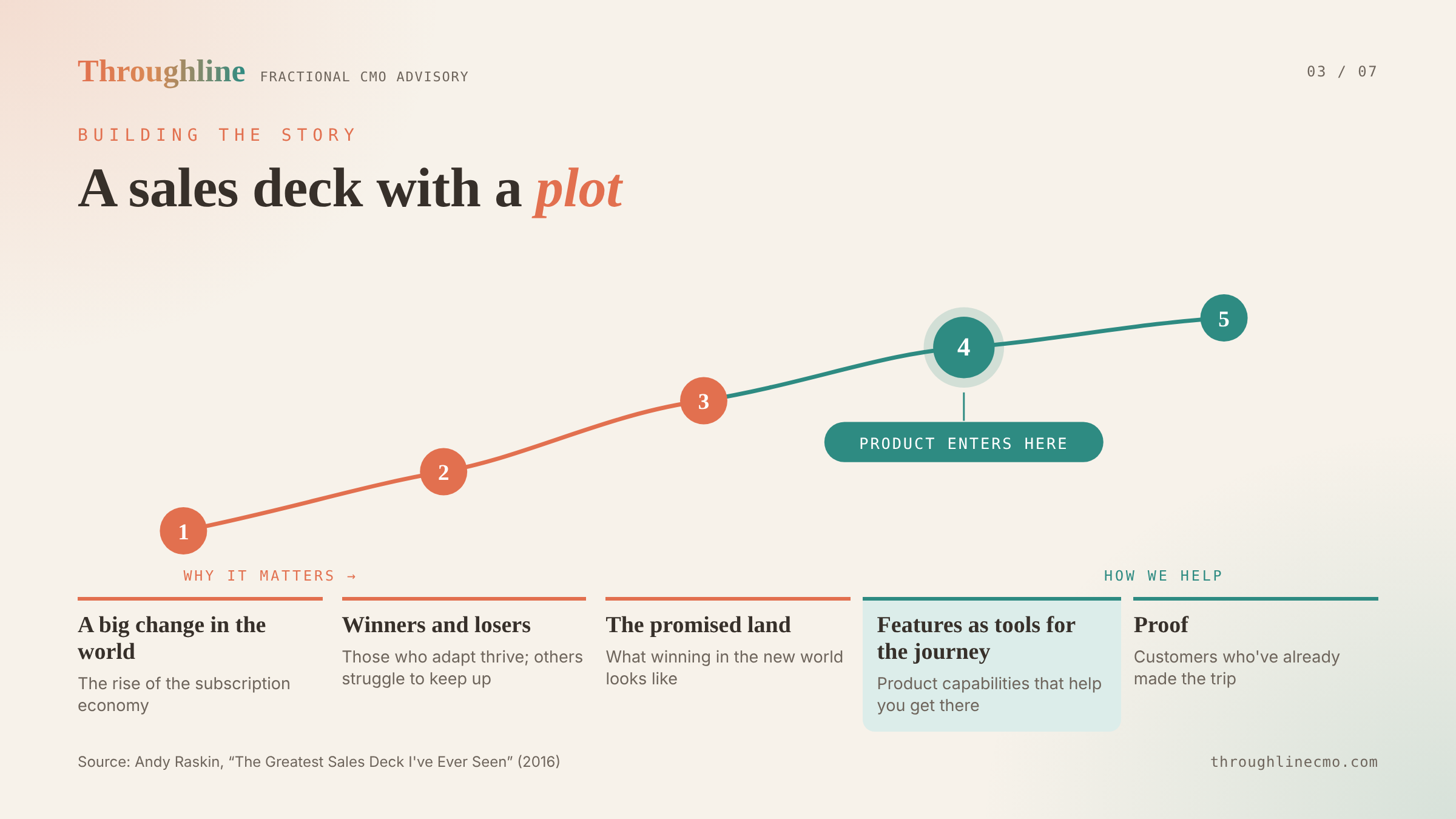
Notice where the product shows up: fourth. By the time a prospect saw a feature, they already understood why it mattered. A former Zuora sales engineer told Raskin that in the early days, the team almost never demoed an actual bill. They helped prospects get excited about joining the subscription economy, and the product made sense in that light.
That takes real confidence. When you’re under pressure to close, it’s natural to lead with features, because features feel concrete. Zuora trusted the story to create the context its features needed.
Growing the Story: From Deck to Movement
A great deck can win deals. Zuora went further and gave the story a home at every stage of the buyer’s journey.
Awareness: Zuora created a proprietary Subscription Economy Index to track the trend’s growth, giving the story data to stand on. In 2018, Tzuo published a book, Subscribed, framed as a playbook for succeeding in the subscription economy.
Consideration: Zuora built an annual conference, also called Subscribed, and took it on the road. By 2019, the series was drawing thousands of attendees across seven countries. Prospects could spend a day inside the story, learning from companies that were already living it.
Decision: The sales deck picked up the same story buyers had been hearing all along, so reps were continuing a conversation rather than starting a new one.
Retention: Customers became the heroes. At its conference, Zuora recognized customers as visionaries and champions of the subscription economy, with awards in categories like Supergrower, Innovator and Transformer.
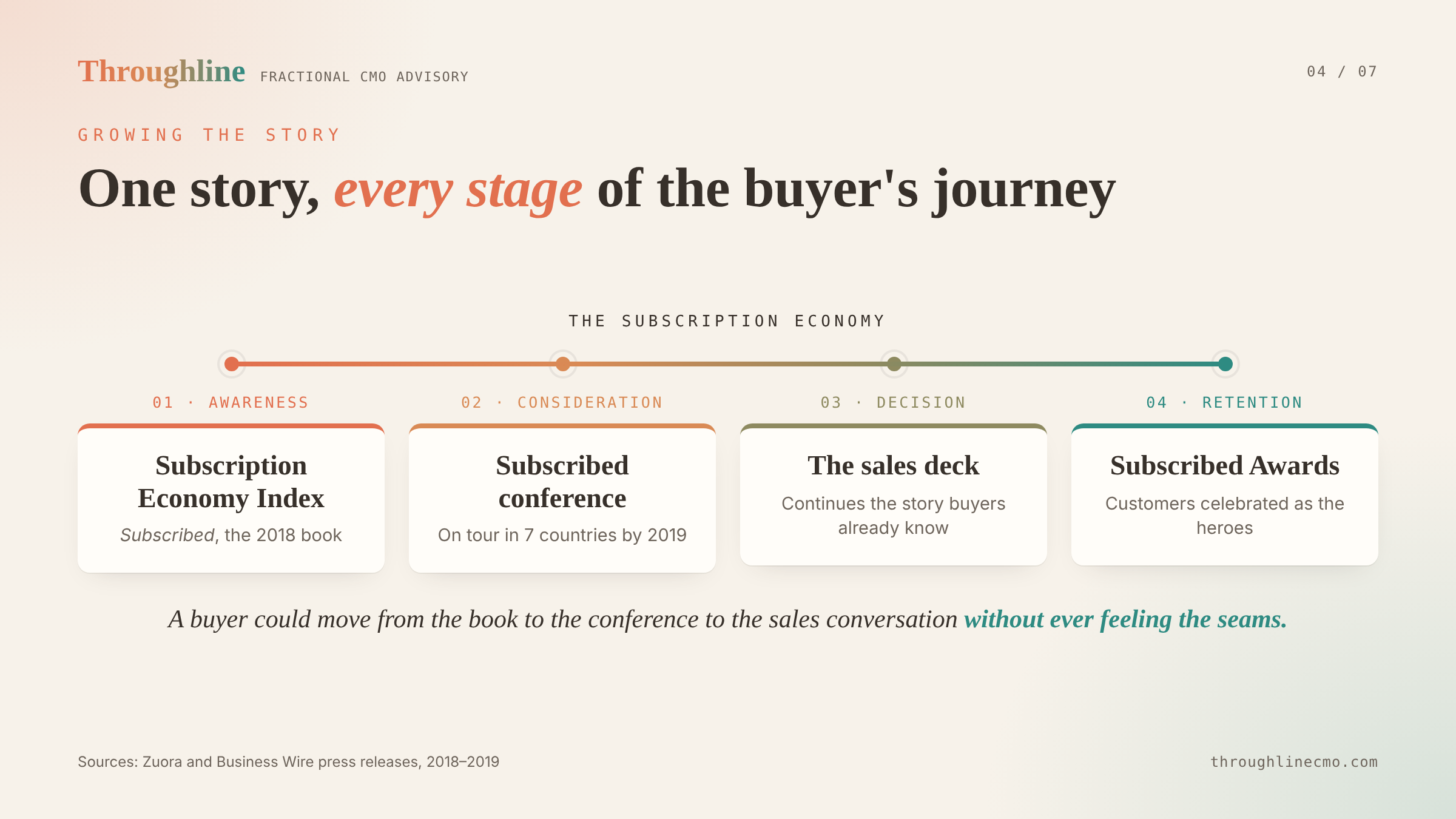
Every stage connected to the one before it. A buyer could move from the book to the conference to the sales conversation without ever feeling the seams.
A Story That Outlasts the Moment
Zuora went public in 2018, and in February 2025 it was taken private by Silver Lake and GIC in a deal valued at about $1.7 billion. Even in that announcement, Tzuo described the company’s history in terms of the same narrative, saying Zuora had championed the shift to the subscription economy since its founding. The investors used the phrase too.
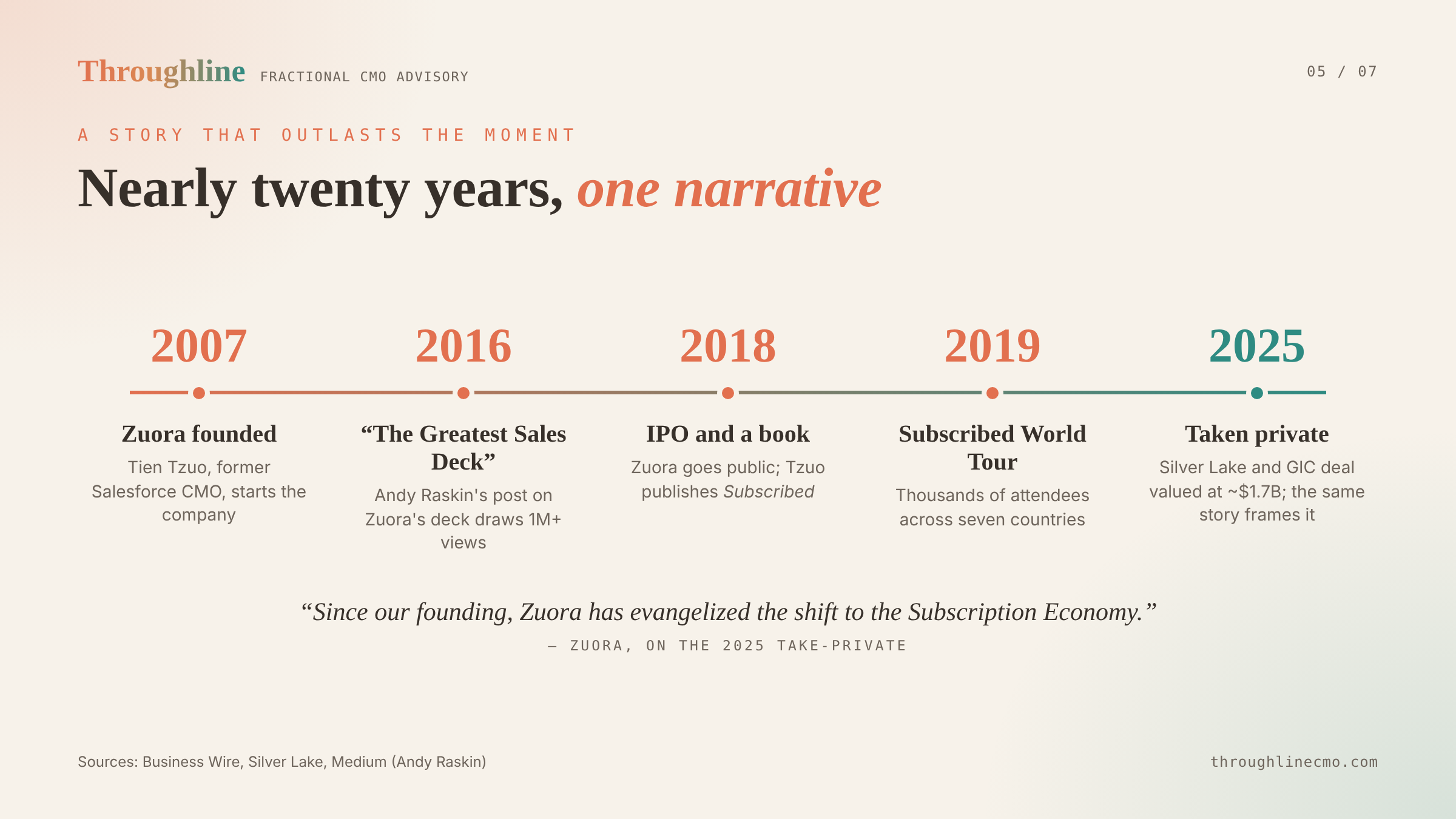
That’s the mark of a story that has become a brand. Nearly twenty years in, the company and the idea are still described together.
Why It Worked
Looking back, three qualities stand out, and none of them require a big budget.
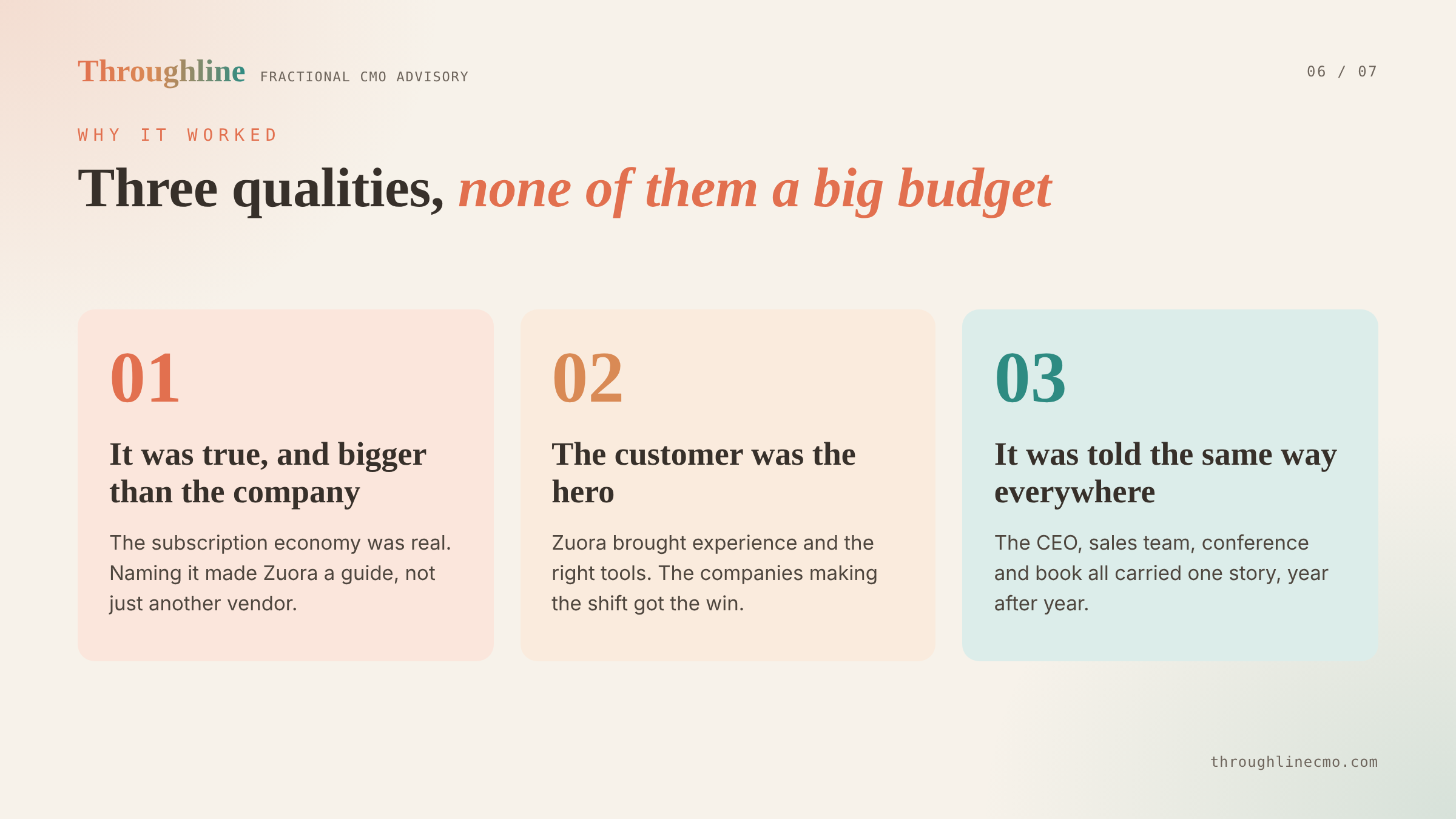
It was true, and bigger than the company. The subscription economy was real. Zuora named it and helped customers make sense of it, which made the company a guide rather than just another vendor.
The customer was the hero. Zuora’s role was the experienced guide with the right tools. The companies making the shift were the ones who got to win.
It was told the same way everywhere. The CEO, the sales team, the conference and the book all carried one story. That consistency is hard for any growing company, especially when different teams own different assets, and it’s what gave the narrative its staying power.
Your Company Has a Story Too
Great businesses are great stories. Zuora’s wasn’t a clever invention layered on top of a billing product. It was already there, in what was changing for its customers. Zuora’s achievement was noticing it, naming it and telling it with conviction.
Most of us won’t write a book or launch a world tour, and we don’t need to. The story is the part that matters, and you can start finding yours this week.
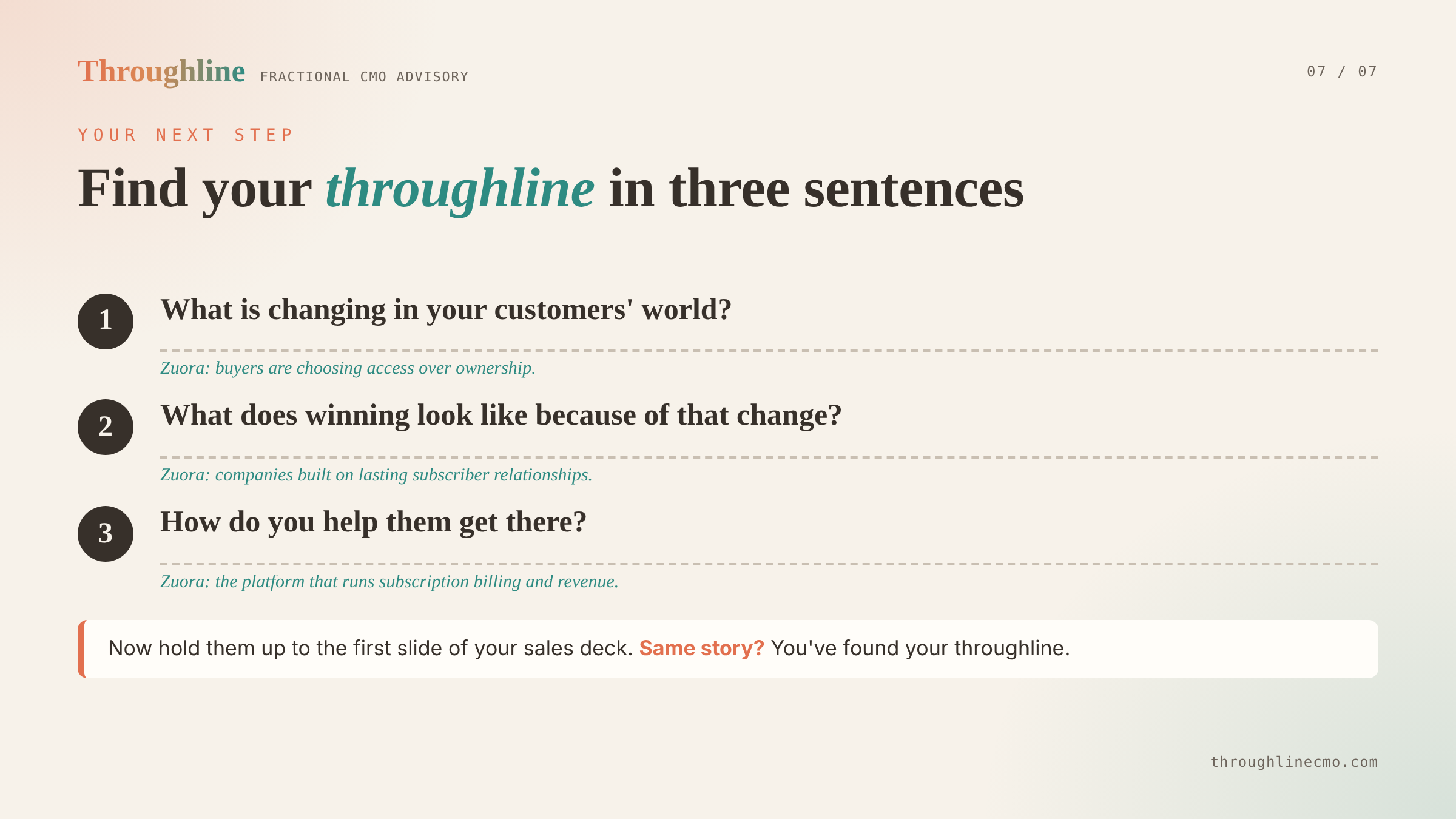
Try writing three sentences: what is changing in your customers’ world, what winning looks like for them because of that change, and how you help them get there. Then put those sentences next to the first slide of your sales deck. If they tell the same story, you’ve found your throughline. If they don’t, you’ve found a great place to begin.
Sources
- Andy Raskin, “The Greatest Sales Deck I’ve Ever Seen” (2016, republished on Medium)
- Andy Raskin, “Is the ‘Greatest Sales Deck’ Great for Savvy Prospects?”
- Andy Raskin on Zuora’s sales engineering approach (LinkedIn)
- Business Wire, “Tien Tzuo, CEO and Founder of Zuora, Launches SUBSCRIBED” (2018)
- Business Wire, “Zuora’s Subscribed World Tour” (2019)
- Zuora, “Zuora Hosts Subscribed ’18”
- Silver Lake, “Silver Lake and GIC Complete Acquisition of Zuora” (2025)